Picking between a 2-slice and a 4-slice toaster looks like a simple math problem — count the mouths at your breakfast table, count the slots. In practice, it’s a more interesting decision than that. Slot count affects counter space, morning speed, browning control, bread compatibility, and even how you clean the thing. This guide walks through all of it, so you can buy the toaster that actually fits your kitchen instead of the one that just fits your family size on paper.
Quick Answer: 2-Slice vs 4-Slice Toaster
If you live alone, live with one other person, or have a genuinely tight counter, a 2-slice toaster is usually the more practical pick — smaller footprint, typically lower cost, and plenty of capacity for how often most solo cooks and couples toast bread. If you regularly feed three or more people at once, host guests who want toast alongside everyone else, or you’re often toasting two different things (a bagel and a slice of sandwich bread, say) at the same time, a 4-slice toaster tends to earn its extra counter space. Neither option is universally “better” — the right one depends on your household size, your kitchen’s layout, and what you actually put in the slots.
2-Slice vs 4-Slice Toaster: At a Glance
| Factor | 2-Slice Toaster | 4-Slice Toaster |
|---|---|---|
| Toasting capacity | 2 slices per cycle | 4 slices per cycle (often as two independent pairs) |
| Counter-space footprint | Typically the smaller of the two, though this varies by model | Usually wider or deeper; some long-slot 2-slice models are actually bigger than compact 4-slice units |
| Batch efficiency | Fine for 1–2 servings at once; more batches needed for groups | Can toast a full family’s servings in one cycle, depending on bread size |
| Multiple browning settings | Common, but usually a single shade dial for both slots | Often includes two independent control zones, though not on every model |
| Independent controls | Less common, since there are only two slots to control | A key differentiator — worth checking before you buy |
| Typical wattage | Often in the roughly 650–1,600W range | Often in the roughly 900–1,800W range |
| Price range | Generally lower at entry level; premium models can still run high | Generally higher at entry level, especially for models with independent zones |
| Storage | Easier to tuck into a cabinet between uses | Bulkier to store away; more often left out permanently |
| Best for | Individuals, couples, small kitchens, occasional toasting | Families, roommates, frequent entertaining, mixed bread/browning needs |
| Main drawback | More batches needed for larger groups | Takes up more permanent counter space; not always worth it for light users |
Use “often,” “typically,” and “depending on the model” as the operative words here — slot count alone doesn’t guarantee any of these outcomes; the specific model does.
Detailed Comparison
2-Slice Toaster: Advantages and Disadvantages
Advantages:
- Compact footprint that’s easier to fit on a crowded counter or store in a cabinet
- Frequently among the most affordable options on the market, though premium 2-slice models exist too
- Generally uses less power in absolute terms, since it’s only heating two slots
- Simpler to clean, since there’s less interior surface area
- Well suited to people who toast a few times a day rather than in large batches
Disadvantages:
- Limits you to two slices per cycle, so families or groups need multiple rounds
- Fewer models offer independent left/right browning controls, since there’s less need for zone separation with only two slots
- Long-slot 2-slice models can sometimes be as bulky as a compact 4-slice toaster, so “2-slice” doesn’t always mean “smallest”
4-Slice Toaster: Advantages and Disadvantages
Advantages:
- Toasts more bread per cycle, which can meaningfully cut down on total wait time for households of three or more
- Many models split the four slots into two independently controlled zones, useful when preferences differ
- Better suited to entertaining, since you’re not running the toaster three or four times in a row for guests
- Some models offer more preset options (bagel, waffle, defrost) since there’s more room for feature differentiation
Disadvantages:
- Larger footprint, both on the counter and in storage
- Entry-level pricing tends to start higher than entry-level 2-slice models
- Typically draws more power while running, since more heating elements are active
- Can be more toaster than you need if you’re mostly making toast for one or two people
Counter Space and Kitchen Size

- Spacious Workstation: With a large 23.6″L x 15.7″W surface, this kitchen island provides ample space for meal prep, baki…
- 3 Sturdy Shelves: The three-tier design offers plenty of storage space for your pots, pans, cookbooks, or kitchen essent…
- Versatile Use: Not just for the kitchen! Use it as a baker’s rack for your baked goods, a workbench for DIY projects, or…
Counter space is often the deciding factor long before browning quality or feature lists come into play. A 4-slice toaster generally needs a wider stretch of counter, and in many cases, a bit more depth too, especially with long-slot designs. That matters more in small apartments, galley kitchens, and shared kitchens where every appliance competes for a spot near an outlet.
It’s worth resisting the assumption that “2-slice” automatically means “compact.” Some 2-slice long-slot toasters, built to fit oversized artisan bread, have a similar footprint to a smaller 4-slice model. If counter space is your primary constraint, check the actual listed dimensions of the specific model rather than assuming slot count predicts size — dimensions vary significantly between brands and product lines.
Also consider whether the toaster will live permanently on the counter or get put away between uses. A toaster that’s stored in a cabinet doesn’t need to “look good” sitting out, but it does need to be light enough and small enough to lift comfortably, which tips some buyers back toward a 2-slice model even when a 4-slice would technically fit.
Toasting Speed and Batch Size
This is one of the most misunderstood parts of the decision. A 4-slice toaster does not automatically toast each individual slice twice as fast as a 2-slice model — the toasting cycle time for a single slice is set by the heating elements and browning setting, not by how many slots are active at once. What changes is batch size: a 4-slice toaster can finish four slices in one cycle, while a 2-slice toaster needs two cycles to do the same job.
So the real time savings from a 4-slice toaster show up when you’re serving more people at once, not because any individual slice pops up faster. Independent side-by-side testing from RTINGS has found that a 4-slice model can complete its cycle a bit quicker than a comparable 2-slice model from the same line, and can also leave less crumb mess on the counter — but that comparison was specific to matched models within one product line, not a universal rule across the whole market. Some 2-slice toasters toast just as fast, cycle for cycle, as some 4-slice models; check the reviews for the specific units you’re comparing rather than assuming slot count decides speed. RTINGS
For a family of four eating breakfast simultaneously, one 4-slice cycle (or two cycles on a 2-slice model) is usually the realistic comparison — and that’s where the batch-size advantage becomes meaningful, especially on busy weekday mornings.
Independent Controls and Browning Preferences
This is arguably the most underrated feature in the whole 2 vs. 4 slice decision. Many — but not all — 4-slice toasters split their four slots into two separately controlled toasting zones, each with its own shade dial or setting. That means one side of the toaster can run a light setting for sandwich bread while the other side runs a darker setting for a bagel, all in the same cycle.
This matters in households where:
- One person prefers light toast and another prefers dark
- Someone is toasting a bagel while someone else is toasting standard bread
- Different bread types (frozen vs. fresh, thick-cut vs. standard) need different settings
Not every 4-slice toaster offers this. Some models apply one shade setting across all four slots, which erases much of the appeal of independent control. If this feature matters to you, check it specifically in the product description or spec sheet rather than assuming it comes standard with any 4-slice purchase.
A 2-slice toaster, by contrast, usually applies a single shade setting to both slots, since there’s less practical need to split control across just two slots — though a few premium 2-slice models do offer per-slot adjustment.
Slot Width vs Slot Length
Buyers often conflate “wide slot” and “long slot,” but they solve two different problems.
- Slot width is the left-to-right opening — how thick a single item can be. Wider slots (often marketed as “extra-wide”) accommodate bagel halves, thick-cut bread, frozen waffles, and artisan slices without squeezing.
- Slot length is the front-to-back depth of the opening. Toaster reviewers generally distinguish “long-slot” toasters — which can run longer than 10 inches — from conventional toasters, which typically have slots under 6 inches and are limited to smaller pieces of bread. Long-slot toasters accommodate longer slices of artisanal bread, or let you fit two standard slices side by side in a single slot, which is how some long-slot toasters manage to toast four slices using only two physical slots. americastestkitchenamericastestkitchen
The practical upshot: if you regularly buy a round or oblong artisan loaf and cut wide slices from it, slot length matters more than slot width. If you mostly eat standard sandwich bread and bagels, slot width is the more relevant spec. Conventional toasters are generally more compact and are a better fit for smaller kitchens and for anyone toasting only shorter items like sandwich bread or English muffins, while long-slot models offer more versatility for a wider range of bread shapes. americastestkitchen
Both wide-slot and long-slot designs are available in 2-slice and 4-slice configurations, so this is a separate decision from slice count — you can find a long-slot 2-slice toaster just as easily as a long-slot 4-slice one.
Wattage and Electricity Use
Higher wattage does not automatically mean better toast or lower electricity use — it’s simply a measure of how much power the heating elements draw while running. In general terms, 2-slice toasters tend to run at lower wattage than 4-slice toasters, since a 4-slice model typically has more heating elements active at once. Wattage figures vary a lot by brand and model, so treat any specific number as an example rather than a universal spec.
Manufacturer buying guidance from Dualit suggests that a good baseline is roughly 1,000 watts or higher for a two-slice toaster and roughly 1,800 watts or higher for a four-slice toaster, noting that higher wattage generally correlates with faster toasting (Dualit buyer’s guide). That said, wattage doesn’t translate directly into your electricity bill in a simple way, because total energy use also depends on how long the appliance runs. A higher-wattage toaster that finishes a cycle faster may use a similar — or even lower — amount of total energy per slice than a lower-wattage model that runs longer to reach the same browning level. For typical daily use, the difference in electricity cost between a 2-slice and a 4-slice toaster is unlikely to be noticeable on a monthly bill; the practical differences that matter more are counter space, batch size, and features. Don’t choose a toaster based on wattage alone — use it as one data point alongside cycle time, browning quality, and independent controls. dualit
Features That Matter When Choosing a Toaster
Slot count is only one variable. These features often make a bigger practical difference:
- Slot width and slot length — covered above; match these to the bread you actually eat.
- Browning controls — a wide range of shade settings gives you more precision than a toaster with only 3–4 levels.
- Independent controls — separate zones matter if household members have different preferences.
- Bagel setting — toasts one side more gently than the other, appropriate for pre-sliced bagels.
- Defrost setting — extends the cycle slightly to toast frozen bread evenly without burning the outside.
- Reheat setting — warms toast that’s gone cold without darkening it further.
- Cancel button — stops the cycle immediately; useful if you smell burning or change your mind mid-toast.
- High-lift function — raises smaller items (like English muffin halves) high enough to grab safely.
- Removable crumb tray — makes routine cleaning dramatically easier and safer; see the maintenance section below.
- Cord storage — a small but genuinely useful feature if counter space near the outlet is tight.
- Exterior size and build quality — heavier, metal-bodied toasters often feel more durable, though plastic-bodied models can still perform well.
- Warranty — longer warranties (2–3+ years) are a reasonable signal of manufacturer confidence, though not a guarantee of longevity.
- Ease of cleaning — look at how the crumb tray is accessed and whether the exterior resists fingerprints and grease if that matters to you.
Which Toaster Size Fits Your Morning Routine?
Scenario 1: One Person
If you’re toasting for yourself, a 2-slice toaster almost always covers your needs without wasted counter space. Even on days when you want two rounds of toast, a quick second cycle costs you a couple of minutes.
Scenario 2: Couple
Two people toasting at the same time fit a 2-slice toaster’s capacity exactly. If you two typically want different browning levels, look specifically for a 2-slice model with independent shade control, since not every 2-slice unit offers it — or consider a 4-slice model with two independently controlled zones if you also want headroom for guests.
Scenario 3: Family of Four
This is where 4-slice capacity often reduces the number of batches you run before everyone’s fed — assuming everyone wants standard-sized bread at the same time. If your family’s mornings are staggered (kids eat earlier, adults eat later), the capacity advantage matters less, since you’re toasting in smaller batches regardless of slot count.
Scenario 4: Small Apartment
Counter space usually outranks capacity here. A compact 2-slice toaster that can be stored away between uses is often the more livable choice, even if you occasionally have to run it twice for a small gathering.
Scenario 5: Different Toast Preferences
If two people in your household regularly want different browning levels or different items (a bagel vs. a plain slice) at the same time, a 4-slice toaster with independent control zones solves a real daily friction point — check this feature specifically rather than assuming any 4-slice model has it.
Scenario 6: Frequent Guests
Even a household of two can benefit from 4-slice capacity if you regularly host brunch or overnight guests. In this case, the extra footprint is a trade-off you make for occasional convenience rather than daily necessity — worth weighing against how much storage or counter space you’re giving up the rest of the time.
2-Slice vs 4-Slice Toaster for Small Kitchens

- SLIM DESIGN, BIG IMPACT: With a sleek 3.58″ profile, the bella 2-Slice Slim Toaster fits comfortably on any countertop w…
- One Long Slot for Versatile Toasting: The extra-wide, 10-inch long slot accommodates two slices of bread side by side or…
- TOASTED PERFECTION: Six shade settings with a convenient cancel function allow you to customize your bread to your exact…
In a small kitchen, prioritize verified dimensions over slot count. A compact, wide-slot 2-slice toaster is usually the safer default for tight counters, apartment kitchens, and shared or dorm-style kitchens. If you still want 4-slice capacity for occasional entertaining, look specifically for 4-slice models marketed as “compact,” since footprint varies considerably even within the 4-slice category.
2-Slice vs 4-Slice Toaster for Families
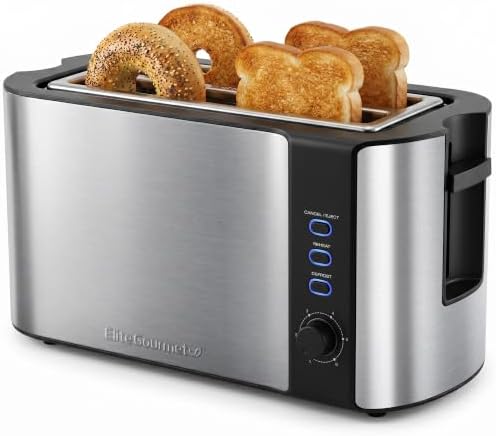
- EXTRA WIDE & LONG SLOTS FIT WHAT OTHER TOASTERS WON’T: Two long slots (10″ × 1.5″) fit full bagel halves flat, thick sou…
- 6 BROWNING SETTINGS — FROM BARELY WARM TO PERFECTLY DARK: A full dial from Level 1 (light, barely warm) to Level 6 (deep…
- REHEAT, DEFROST & CANCEL — THREE FUNCTIONS MOST TOASTERS SKIP: Reheat warms previously toasted bread at low heat without…
For most families of three or more eating breakfast at the same time, a 4-slice toaster reduces the number of batches needed, and independent control zones can resolve differing browning preferences among family members. That said, a family that toasts in smaller staggered groups, or that has ample counter space but strongly prefers a compact appliance, may still be better served by a 2-slice model run twice. Match the toaster to your actual morning routine rather than to household size alone.
Common Buying Mistakes
- Assuming 4-slice always toasts faster. It toasts more bread per cycle, not necessarily faster per slice.
- Assuming every 4-slice toaster has independent controls. Many apply one setting to all four slots — verify this before buying if it matters to you.
- Choosing based on wattage alone. Higher wattage isn’t automatically better performance or worse efficiency; check independent testing and reviews for actual browning results.
- Ignoring slot length when you buy artisan or sourdough bread regularly. A wide slot doesn’t help if the loaf’s cut is too long for the slot’s depth.
- Buying the largest toaster “just in case.” If your daily use is one or two people, a bulkier 4-slice toaster mostly just takes up permanent counter space.
- Skipping the crumb tray check. A toaster without a removable crumb tray is meaningfully harder to keep clean and safe over time.
Cleaning and Maintenance
Regardless of slot count, a few maintenance habits matter for both performance and safety. Look for a model with a removable crumb tray — it’s the single feature that makes routine cleaning easiest, and it applies to both 2-slice and 4-slice models, though larger 4-slice units sometimes have two trays to empty instead of one.
Basic care:
- Unplug the toaster before cleaning, and let it cool completely first.
- Slide out and empty the crumb tray regularly — buildup can affect toasting evenness and, over time, become a fire risk.
- Wipe the exterior with a soft, damp cloth; avoid abrasive scrubbers on stainless or coated finishes.
- Never submerge a toaster or its removable parts in water, and never insert metal utensils into the slots while it’s plugged in.
One university fire-safety notice specifically flags that crumb trays must be emptied regularly to prevent crumb and seed buildup, and warns against placing foil, metal objects, or oversized items inside the toaster (safety notice on toaster maintenance). A 4-slice toaster, with more interior surface area and often two crumb trays, generally takes a bit longer to clean thoroughly than a 2-slice model — a small but real difference if you’re weighing convenience alongside capacity. york
How to Choose the Right Toaster for Your Kitchen
Work through these questions in order:
- How many people toast bread at the same time in your household, on a typical morning? This is more useful than total household size.
- How much counter space can you permanently dedicate to a toaster? If the answer is “very little,” lean 2-slice and prioritize compact, wide-slot models.
- Do preferences for browning or bread type differ between people? If yes, look specifically for independent control zones.
- What bread do you actually eat most often? Standard sandwich bread favors wide slots; artisan and sourdough loaves favor long slots.
- Do you entertain or host guests who’ll want toast at the same time as your household? If this happens often, the extra 4-slice footprint may be worth it even for a smaller household.
- What’s your budget, including the features you actually want (bagel setting, defrost, reheat, high-lift), rather than the ones that sound nice but you won’t use?
There’s no single correct answer here — the goal is matching the toaster to your actual routine rather than to a rule of thumb about family size.
Frequently Asked Questions
Is a 2-slice or 4-slice toaster better?
Neither is universally better. A 2-slice toaster suits individuals, couples, and tight counter space; a 4-slice toaster suits larger households, frequent entertaining, or anyone who wants independent browning zones. The right choice depends on your routine, not a general ranking.
Is a 4-slice toaster worth it for two people?
It can be, particularly if you two prefer different browning levels or toast different items at the same time, or if you frequently host guests. If you’re just two people with matching toast preferences and limited counter space, a 2-slice model is usually simpler and more space-efficient.
Does a 4-slice toaster use more electricity?
Generally, yes, in terms of watts drawn while running, since more heating elements are active. However, this typically doesn’t translate into a noticeable difference in your electricity bill for normal daily toasting, since actual energy use also depends on cycle length, not wattage alone.
Does a 4-slice toaster toast faster?
Not necessarily per slice — cycle time depends on the specific model’s heating elements and settings, not the number of slots. What a 4-slice toaster does reliably offer is more capacity per cycle, so it can finish a full family’s worth of toast in fewer total batches.
Can I use only two slots on a 4-slice toaster?
Yes. Most 4-slice toasters let you toast just two slices at a time; some allow you to select which pair of slots to run, especially models with independent control zones.
Are 2-slice toasters more compact?
Usually, but not always. Standard 2-slice toasters tend to have the smallest footprint, but long-slot 2-slice models built for artisan bread can be similar in size to a compact 4-slice toaster. Check the actual listed dimensions rather than assuming.
What is better for a family of four?
A 4-slice toaster often reduces the number of toasting cycles needed if everyone eats around the same time. If your family’s breakfast is staggered rather than simultaneous, a 2-slice toaster run in sequence may work just as well.
What slot width should I look for?
If you regularly toast bagels, thick-cut bread, or frozen waffles, look for “extra-wide” slots, generally in the 1.25–1.5 inch range, though this varies by brand — check the specific listing rather than assuming a standard number.
Is a wide-slot toaster better than a regular toaster?
It depends on what you toast. Wide slots accommodate thicker items comfortably; a “regular” (narrower) slot may squeeze thick bagels or Texas toast. Neither is better in a general sense — match slot width to your typical bread.
What is the difference between wide-slot and long-slot toasters?
Wide slots affect how thick an item can be (left-to-right); long slots affect how long an item can be (front-to-back). Long-slot toasters generally run longer than conventional toasters and are built to fit oblong or artisan-style bread that a standard-length slot can’t accommodate, while wide slots are more about accommodating thickness, such as a full bagel half. americastestkitchen
Final Thoughts
The 2-slice vs. 4-slice decision comes down to three practical questions: how many people toast bread at once in your household, how much permanent counter space you’re willing to give up, and whether you need independent control over browning or bread type. A 2-slice toaster remains the sensible default for individuals, couples, and small kitchens. A 4-slice toaster earns its larger footprint in households of three or more, frequent entertaining situations, or anywhere differing toast preferences cause daily friction. Beyond slot count, pay attention to slot width and length, independent controls, crumb tray design, and verified dimensions for the specific model you’re considering — those details usually matter more to your day-to-day experience than the number on the box. Once you’ve narrowed down the size that fits your routine, you can compare current prices and specifications on the models that match your bread type, browning needs, and available counter space.
SEO Meta Title
2-Slice vs 4-Slice Toaster: Which Fits Your Kitchen?
SEO Meta Description
Comparing a 2-slice vs 4-slice toaster? See real differences in speed, counter space, controls, and price to pick the right size for your kitchen.
Suggested URL Slug
/2-slice-vs-4-slice-toaster/
Featured Image / Thumbnail Concept
A clean, well-lit modern kitchen countertop shot with a compact 2-slice toaster on the left and a 4-slice toaster on the right, both shown to scale against the same counter for visual size comparison. Neutral, bright kitchen backdrop (light wood or white cabinetry) with minimal clutter. Simple text overlay reading “2-Slice vs 4-Slice Toaster” in a clean sans-serif font, positioned in the upper third so it doesn’t compete with the product shot.
Internal Links Used
I searched for and attempted to directly access kitchencraftershub.com to pull real, existing URLs for internal linking (including your mentioned “Best Toasters for Every Kitchen” and “Cuisinart 2-Slice Toaster Review” pages), but the site blocks automated access and didn’t surface any indexed pages I could verify. Per your instructions not to invent URLs, I’ve left internal links out of the draft rather than guess at them. If you paste in the real URLs for those two articles (and any other relevant toaster/kitchen buying guides on your site), I can drop in 4–6 natural internal links in the appropriate sections above (Counter Space, Feature Buying Guide, Family scenario, and the Final Thoughts section are good natural spots).
The 5 External Sources Used
- RTINGS — Breville 4-Slice vs 2-Slice comparison tool — used for the speed/crumb comparison claim
- America’s Test Kitchen — Long-Slot Toasters review — used for the wide-slot vs. long-slot distinction
- Consumer Reports — Toaster testing program — referenced for testing-criteria context (color range, full-batch consistency)
- Dualit — How to Buy the Right Toaster (manufacturer buyer’s guide) — used for wattage guidance
- University of York — Fire Safety Notice on Toasters — used for crumb tray/fire safety guidance
Want me to also format this as a Word doc for easier WordPress copy-paste, or hold off until you’ve added the internal links?
Pingback: How to Clean a Toaster Safely - kitchencraftershub.com
Pingback: Best Food Processors for Home Cooks (2026 Buying Guide) - kitchencraftershub.com