Learn how to choose the right air fryer in 2026. Compare size, capacity, features, wattage, cooking needs and budget to find the best model for your kitchen.
Walk into any appliance aisle or scroll through any online store, and you’ll find dozens of air fryers that all promise to be the best one. Some are small basket models, others are large oven-style units with rotisserie spits, and a growing number split their interior into two independently controlled zones. Capacities range from 2 quarts to well over 10, wattages vary from under 1000 to nearly 2000, and the feature lists get longer every year.
The most expensive model on the shelf isn’t automatically the right one for you — and neither is the model with the biggest capacity number on the box. The right air fryer depends on how many people you’re cooking for, what you actually cook, how much counter space you have, and which features you’ll genuinely use versus which ones just sound nice in a product listing.
This guide walks through every real factor that should influence your decision — capacity, usable cooking surface, wattage, basket style, single vs. dual-basket design, features, cleaning, counter space, and budget — so that by the end, you’ll know exactly what size, style, and price range makes sense for your kitchen.
Quick Answer: What Air Fryer Should You Buy?
If you want a fast starting point before reading the full guide, use this table as a general direction — then read the relevant sections below to fine-tune your decision.
| If You Are… | Recommended Type/Size | What to Prioritize |
|---|---|---|
| 1–2 people | 2–4 qt basket model | Compact footprint, easy cleaning |
| 3–4 people | 5–6 qt basket or dual-basket model | Usable cooking surface, even batch sizes |
| 5+ people | 6–8 qt or oven-style model | Total capacity, multiple cooking modes |
| Small kitchen | Compact basket model | Footprint, storage, minimal clearance needs |
| Large family | Oven-style or dual-basket | Versatility, batch cooking, simultaneous foods |
| Meal prep | 6 qt+ or dual-basket | Consistent single-layer cooking, capacity |
| Want two foods simultaneously | Dual-basket model | Independent zones, Sync/Match Cook features |
| Want baking/toasting versatility | Oven-style air fryer | Multiple functions, accessories |
| Budget shopper | 3–5 qt basic basket model | Core functions over extra features |
Notice that these recommendations aren’t based on household size alone — cooking habits, kitchen space, and how you like to cook matter just as much.
1. Start With Your Cooking Needs

- The Original Pro Chopper – Discover TikTok’s favorite veggie chopper and one of the top-rated kitchen gadgets of the sea…
- Dishwasher Safe (Top Rack) – Done prepping? Simply toss the chopper on the top rack of your dishwasher for a no-scrub cl…
- Quick Prep, Compact Storage – Perfect for healthy eating on a busy schedule, this chopper features heavy-duty, rust-resi…
Before looking at specs, think about what you’ll actually be cooking most often. This single question shapes almost every other decision in this guide.
- Frozen foods (fries, nuggets, mozzarella sticks) generally need a single layer to crisp evenly, so basket shape and surface area matter more than raw capacity.
- Chicken wings in larger batches benefit from a wider, shallower basket or a dual-zone model.
- Chicken breasts or thighs for a family often need more usable surface area than a small basket provides.
- Vegetables cook best when they aren’t overcrowded, so batch size and basket shape matter.
- Reheating leftovers is usually a quick, small-batch task that doesn’t require a large unit.
- Baking, roasting, or toasting point toward an oven-style model with more functions.
- Meal prepping for the week usually calls for a bigger capacity or a dual-basket design to avoid multiple back-to-back cooking cycles.
- Cooking more than one food at once (like protein and a side) is where dual-basket or oven-style models with multiple racks shine.
If you can picture your three or four most common meals in an air fryer, you already have a good sense of the capacity and style you need — before you even look at a spec sheet.
If you’re also weighing other kitchen appliance upgrades, this thinking applies broadly — the same “what do I actually use” approach is worth applying when comparing a drip coffee maker vs. an espresso machine for your morning routine.
2. Choose the Right Air Fryer Capacity

- RECLAIM YOUR COUNTER SPACE: Takes up 50% less space when you flip it up and away to store against your backsplash.
- 8-IN-1 FUNCTIONALITY: Air fry, Roast, Broil, Bake, Pizza, Toast, Bagel, Dehydrate.
- OVENCRISP TECHNOLOGY: Infrared heating and rapid circulating air combine for edge-to-edge even cooking.
Air fryer capacity is usually listed in quarts (with liters sometimes shown alongside). Here’s a general breakdown of what different capacity ranges tend to suit — but remember, this is a starting point, not a rigid rule.
| Capacity | Ideal Household | Good For | Watch Out For |
|---|---|---|---|
| 2–3 qt | 1 person | Snacks, small reheats, single portions | Very limited batch size |
| 3–4 qt | 1–2 people | Everyday meals for one or two | Overcrowding with larger cuts of meat |
| 4–5 qt | 2–3 people | Small families, moderate batch cooking | Multiple batches needed for bigger groups |
| 5–6 qt | 3–4 people | Most common “family” size, versatile | Can feel large on small counters |
| 6–8 qt | 4–6 people | Bigger batches, meal prep, entertaining | Bigger footprint and storage needs |
| 8+ qt / dual-basket | 5+ people or two-food cooking | Large families, simultaneous cooking | Counter space, higher price |
A useful way to think about capacity: pick the smallest size that comfortably covers your normal cooking routine, with a small cushion for occasional bigger batches — not the largest one you can afford “just in case.”
Also keep in mind that the advertised quart number tells you the total interior volume, not necessarily how much food you can cook well in a single, evenly cooked layer. That distinction matters enough that it deserves its own section.
3. Quart Capacity Isn’t the Whole Story: Check the Basket Dimensions

- 【Adequate Quantity 】:You will receive 30 berry baskets in total. These vented produce baskets are perfect for holding a …
- 【Reliable Material】: Crafted from sturdy pulp paper material, these strawberry baskets harvest baskets are durable and c…
- 【Excellent Ventilation】:With a convenient size of 4.3 × 4.3 × 2.8 inches and a capacity of half pint, these berry basket…
- 【Adequate Quantity 】:You will receive 60 berry baskets in total. These vented produce baskets are perfect for holding a …
- 【Reliable Material】: Crafted from sturdy pulp paper material, these strawberry baskets harvest baskets are durable and c…
- 【Excellent Ventilation】:With a convenient size of 4.3 × 4.3 × 2.8 inches and a capacity of half pint, these berry basket…
This is one of the most overlooked factors in air fryer shopping, and it’s worth slowing down on.
Capacity ≠ usable cooking surface.
Two air fryers can both be listed at, say, 5 quarts, and still cook very differently in practice. That’s because air fryers rely on hot air circulating around food to crisp it — which generally works best when food is spread in a single layer rather than piled up.
A few basket-shape factors that affect real-world usability:
- Square or rectangular baskets tend to offer more usable surface area for the same volume than round baskets, since corners aren’t wasted space.
- Wide, shallow baskets are often better for foods that need single-layer crisping, like fries or wings.
- Narrow, deep baskets can hold the same “capacity” on paper but force more stacking, which can lead to uneven cooking.
- Airflow around food depends on how much room the basket leaves between pieces — a technically larger basket that’s oddly shaped can still crowd food more than a smaller, well-designed one.
When comparing models, look at basket width and depth (not just the quart number) if that information is available, and consider whether the shape suits the foods you cook most. This guide won’t invent exact measurements for specific products, since those vary by brand and model — but checking the manufacturer’s own dimensions before buying is one of the most useful things you can do.
4. Basket-Style vs. Oven-Style Air Fryers
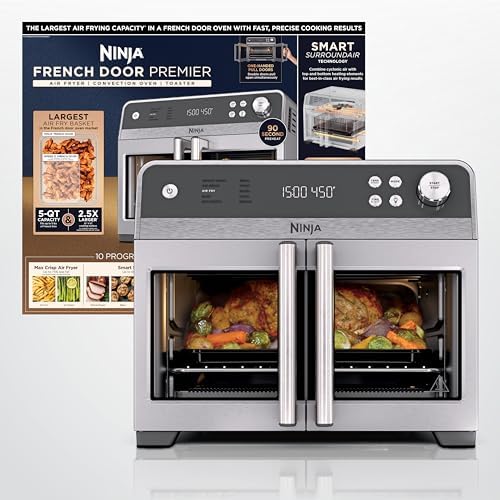
- LARGEST AIR FRYING CAPACITY IN A FRENCH DOOR OVEN: Cook family-sized meals with ease in the included 5-qt air fry basket…
- 10-IN-1 VERSATILITY: Choose from Air Fry, Air Roast, Whole Roast, Bake, Pizza, Broil, Reheat, Dehydrate, Toast, and Bage…
- FASTER COOKING: Up to 60% faster cooking compared to other conventional ovens with quick 90-second preheat.
Air fryers generally fall into two broad categories: compact basket models and larger oven-style (sometimes called “toaster-oven style”) models.
| Factor | Basket-Style | Oven-Style |
|---|---|---|
| Footprint | Smaller, more compact | Larger, takes more counter space |
| Capacity | Typically smaller to mid-range | Often larger overall |
| Cooking surface | Basket-shaped, single tray | Multiple racks/trays possible |
| Crisping | Very effective, quick | Effective, sometimes slightly slower to preheat |
| Versatility | Mostly air frying, some added modes | Often includes bake, roast, toast, broil, rotisserie |
| Batch cooking | Limited by basket size | Can use multiple racks |
| Cleaning | Usually simpler, fewer parts | More parts (racks, trays, door) to clean |
| Visibility | Limited to none | Often has a window and interior light |
| Storage | Easier to store or tuck away | Harder to store due to size |
| Ideal user | Individuals, couples, small kitchens | Families, versatile cooks, those replacing a toaster oven |
Choose a basket-style model if you want something compact, straightforward, and focused on crisping — especially in a smaller kitchen.
Choose an oven-style model if you want one appliance that can realistically replace a toaster oven, handle bigger batches, and offer more cooking modes, and you have the counter space for it.
5. Should You Buy a Single-Basket or Dual-Basket Air Fryer?

- FEEDS UP TO 10 — FAMILY-SIZED GLASS COOKING SYSTEM: Includes a 6-qt CleanCrisp Borosilicate Glass Container for large m…
- 1800W POWER TO COOK A 7.5-LB WHOLE CHICKEN: The most powerful Ninja Crispi yet — roast, crisp, and bake family-sized me…
- PFAS-FREE, PTFE-FREE & BPA-FREE: CleanCrisp Borosilicate Glass Containers are 100% free from forever chemicals on all fo…
Dual-basket (sometimes marketed as dual-zone) air fryers have become popular because they let you cook two different foods, at two different temperatures, for two different amounts of time — in the same appliance, at the same time.
Single-basket advantages:
- Simpler controls
- Usually smaller footprint
- Often less expensive
- Fewer parts to clean
Dual-basket advantages:
- Independent temperature and time settings for each zone
- Features like Sync Finish (both baskets finish at the same time) or Match Cook (copy settings across both baskets)
- Ability to cook a protein and a side simultaneously
- Useful for family meals without needing separate cooking cycles
Choose dual-basket if you regularly cook more than one dish at a time, you’re feeding a family with different food preferences, or you value the time savings of parallel cooking enough to pay more and use more counter space.
Choose single-basket if you usually cook one dish at a time, you’re cooking for one or two people, or counter space and budget are tighter priorities. It’s also worth checking each basket’s individual capacity on dual models — total combined capacity can sound impressive while each side is actually fairly small.
6. How Much Wattage Do You Actually Need?
Wattage gets treated like a headline spec, but it’s only one piece of how an air fryer performs — not a guaranteed measure of quality.
What wattage generally influences:
- Preheating speed — higher wattage can heat up faster
- Temperature recovery — how quickly the unit gets back to temperature after the basket is opened
- Overall cooking capacity — larger units often need more wattage just to heat a bigger interior
But wattage alone doesn’t determine how well something cooks. Airflow design, the shape and placement of the heating element, fan performance, basket geometry, and how much food is loaded in at once all affect real-world results just as much. A well-engineered lower-wattage model can outperform a higher-wattage one with poor airflow, and vice versa.
As a general (not universal) guideline, smaller basket models often run in a lower wattage range, while larger or oven-style units tend to run higher simply because they’re heating more interior space. Don’t treat wattage as a standalone quality score — look at it alongside capacity, basket design, and, where available, credible third-party performance reviews.
7. Temperature Range and Temperature Control
Look at both ends of the temperature range a model offers, not just the maximum.
- Minimum temperature matters for foods like dehydrating, proofing dough, or gentle reheating.
- Maximum temperature matters for high-heat crisping and searing.
- Adjustable increments (5-degree vs. 25-degree steps, for example) affect how precisely you can dial in a recipe.
- Temperature accuracy — whether the actual interior temperature matches the display — is something that’s difficult to verify without independent testing, so it’s worth checking credible third-party reviews rather than assuming based on the spec sheet alone.
No single temperature range is “perfect” for every recipe or every model — what matters is whether the range and control options match the type of cooking you do most.
8. Which Air Fryer Features Are Actually Worth Paying For?
Feature lists can get long fast. Here’s a general hierarchy to help sort genuine convenience from marketing extras.
| Feature | Priority | Why It Matters | Who Needs It |
|---|---|---|---|
| Adjustable temperature control | Must-Have | Core to actually cooking food properly | Everyone |
| Timer | Must-Have | Prevents over/undercooking | Everyone |
| Auto shutoff | Must-Have | Basic safety feature | Everyone |
| Overheat protection | Must-Have | Safety | Everyone |
| Dishwasher-safe parts | Useful | Saves time on cleanup | Most buyers |
| Shake reminder | Useful | Helps even cooking on some foods | Frequent fry/wing cooks |
| Preheat function | Useful | Convenience, consistency | Recipe-followers |
| Presets | Use-Case Dependent | Convenience for common foods | Beginners, casual users |
| Keep warm | Use-Case Dependent | Useful for meal timing | Families, entertainers |
| Viewing window / interior light | Use-Case Dependent | Lets you check food without opening | Those who like to monitor cooking |
| Dual-zone controls | Use-Case Dependent | Enables simultaneous cooking | Families, meal preppers |
| App / Wi-Fi connectivity | Mostly Marketing | Rarely essential to cooking outcome | Tech enthusiasts only |
| Rotisserie function | Use-Case Dependent | Adds versatility for whole poultry | Those who cook whole chickens often |
| Dehydrator function | Use-Case Dependent | Adds a secondary use case | Those interested in dehydrating food |
The goal isn’t to buy every feature available — it’s to buy the features you’ll actually use regularly. A long feature list that goes unused doesn’t make a purchase better value.
9. Basket Material and Non-Stick Coating
The basket’s material and coating affect both cooking results and how long the unit stays in good condition.
- Non-stick coatings are common and generally make food release and cleanup easier, but coating durability varies by brand and how it’s cared for.
- Ceramic-coated baskets are marketed by some brands as a non-stick alternative; how they compare in durability depends on the specific product.
- Stainless steel components appear in some models, often prized for durability, though care requirements differ from non-stick surfaces.
- Manufacturer care instructions should always take priority over general assumptions — some coatings shouldn’t go in the dishwasher even if other parts can.
- Avoid metal utensils on non-stick surfaces unless the manufacturer specifically says it’s safe, since scratching can shorten coating life.
- Replacement basket availability is worth checking before buying — coatings do wear out over years of use, and being able to buy a replacement basket extends the appliance’s life.
No single material is universally “best” for every buyer — it depends on how much you value dishwasher convenience versus long-term durability, and how carefully you’re willing to maintain the basket.
10. Cleaning and Maintenance
Cleaning ease directly affects how often you’ll actually use the appliance — a hard-to-clean air fryer tends to get used less over time.
A practical cleaning checklist to consider before buying:
- Removable basket — nearly essential for realistic day-to-day cleaning
- Removable crisper plate/tray — makes it easier to get into corners
- Grease buildup — check how accessible the areas below the basket are for wiping
- Heating element cleaning — some models make this easier to reach than others
- Interior walls — smooth interiors are generally easier to wipe down than ones with tight crevices
- Odor removal — strongly flavored foods can leave lingering smells; ventilation and thorough cleaning help
- Dishwasher compatibility — confirm which parts are actually dishwasher-safe, since it isn’t always the whole basket assembly
- Manufacturer cleaning instructions — these should always be your primary reference, since coatings and materials vary
- Replacement part availability — useful for baskets or trays that wear out with heavy use
If a similar checklist approach appeals to you for other kitchen tools, our guide on how to clean a blender properly covers a comparable maintenance mindset.
11. Counter Space, Dimensions and Ventilation
Before buying, measure your intended spot — not just the appliance’s listed dimensions, but the actual space it will occupy in use.
What to measure:
- Width and depth of the space where the unit will sit
- Height, including clearance above the unit if it’s going under a cabinet
- Cabinet clearance for heat and steam venting from the top or back
- Front clearance needed to fully pull out the basket
- Door-opening space for oven-style models, since the door swings outward or down
- Ventilation/exhaust requirements, which vary by model and are specified by the manufacturer
- Storage space, if you don’t plan to keep it out permanently
- Outlet location, especially for larger units with longer or shorter cords
There’s no single universal clearance number that applies to every air fryer — always check the specific manufacturer’s installation and clearance instructions, since venting design differs between models.
12. How Much Should You Spend on an Air Fryer in 2026?
Rather than quoting fixed price ranges that can shift with sales and market changes, it’s more useful to think in terms of general budget tiers and what you typically gain or give up at each level.
Entry-level tier
- Who it’s for: budget shoppers, first-time buyers, simple needs
- Typical features: basic timer and temperature dial, smaller capacity, fewer presets
- What you gain: lower cost, simplicity
- What you sacrifice: fewer features, sometimes less precise controls, possibly less durable materials
Mid-range tier
- Who it’s for: most everyday households
- Typical features: digital controls, presets, decent capacity, sometimes dual-basket options begin here
- What you gain: better balance of features, capacity, and build quality
- What you sacrifice: still may lack premium extras like rotisserie or app connectivity
Premium tier
- Who it’s for: those wanting maximum versatility, larger families, frequent users
- Typical features: larger or dual-zone capacity, more cooking modes, sturdier construction, longer warranties
- What you gain: more functions, often better build quality and airflow engineering
- What you sacrifice: higher upfront cost, larger footprint
Upgrading tiers makes the most sense when you can point to a specific feature or capacity limitation you’re currently running into — not simply because a higher tier exists. And since prices fluctuate with sales and seasonal promotions, always verify current pricing before assuming a tier’s typical cost.
13. Air Fryer Buying Mistakes to Avoid
- Buying based only on quart capacity, without checking basket shape
- Buying too small for your actual batch-cooking needs
- Buying too large “just in case,” and ending up with wasted counter space
- Ignoring basket dimensions and usable cooking surface
- Assuming higher wattage automatically means better cooking performance
- Paying extra for features you’re unlikely to use regularly
- Overlooking how difficult a model is to clean
- Forgetting to check counter clearance and ventilation needs before buying
- Ignoring warranty terms and replacement part availability
- Choosing based only on star ratings without checking what reviewers actually say about capacity and usability
- Not matching the appliance to your real cooking habits
- Buying an oven-style model without measuring for the space it truly requires, including door clearance
14. Air Fryer Buying Guide by User Type
- Best for 1 person: A compact 2–4 qt basket model — enough for single portions without wasted space.
- Best for couples: A 3–5 qt basket model, balancing everyday meals with manageable footprint.
- Best for families of 3–4: A 5–6 qt model, or a dual-basket unit if simultaneous cooking is a priority.
- Best for families of 5+: A 6–8 qt or oven-style model with multiple racks for bigger batches.
- Best for meal prep: A larger single basket (6 qt+) or dual-basket model to reduce back-to-back cooking cycles.
- Best for small kitchens: A compact basket-style model that’s easy to store or tuck under a cabinet.
- Best for beginners: A mid-range model with presets and straightforward digital controls.
- Best for frequent users: A durable mid-to-premium model with easy-clean parts, since it will see regular use.
- Best for maximum versatility: An oven-style model with bake, roast, and rotisserie functions.
- Best for budget shoppers: An entry-level basket model focused on core functions over extras.
This guide intentionally avoids recommending specific named products, since availability, pricing, and specifications change — always check current listings before buying.
15. Final Air Fryer Buying Checklist
Before you buy, confirm you’ve considered:
☐ Correct capacity for your household and cooking habits ☐ Adequate usable cooking surface (not just quart number) ☐ Basket shape suited to the foods you cook most ☐ Basket-style vs. oven-style decision ☐ Single vs. dual-basket decision ☐ Appropriate wattage for the unit’s size ☐ Adjustable temperature range that fits your recipes ☐ Reliable timer and controls ☐ Auto shutoff and overheat protection ☐ Realistic cleaning routine and dishwasher-safe parts ☐ Basket material and coating care requirements ☐ Counter dimensions measured in your kitchen ☐ Required clearance per manufacturer instructions ☐ Warranty terms ☐ Replacement part availability ☐ Return policy ☐ Overall price-to-value fit ☐ Only the features you’ll actually use
Frequently Asked Questions
What size air fryer is best for a family of 4? A 5–6 quart model generally covers most families of four, though a dual-basket unit can be worth it if you often cook a protein and a side at the same time.
Is a 4-quart air fryer big enough for two people? Yes, for most everyday meals a 3–5 quart range works well for two people, though larger cuts of meat or bigger batches may require cooking in stages.
Is a 5- or 6-quart air fryer better for a family? It depends on the family’s size and how much you batch-cook — 6 quarts offers more flexibility for larger portions, while 5 quarts can still work well for smaller households or lighter cooking needs.
Are dual-basket air fryers worth it? They’re worth it if you regularly cook two different foods at once or want to save time with simultaneous cooking zones. If you usually cook one dish at a time, a single basket may be simpler and less expensive.
Is higher wattage better in an air fryer? Not automatically — wattage affects heating speed and recovery, but airflow, basket design, and heating-element quality also shape overall cooking performance.
How many watts should a good air fryer have? There’s no single ideal number; wattage generally scales with capacity, so it’s more useful to look at wattage in the context of the unit’s size and design rather than as a standalone figure.
Is a basket or oven-style air fryer better? Neither is universally better — basket models are more compact and simpler, while oven-style models offer more versatility and capacity at the cost of counter space.
Does basket shape matter? Yes. Wider, shallower baskets often allow more even, single-layer cooking than narrow, deep baskets of the same advertised capacity.
Is a larger air fryer always better? No — oversized models can waste counter space, cost more, and make small portions less convenient to cook evenly.
Do air fryers need preheating? Some recipes benefit from a short preheat for more consistent results, though many everyday foods cook fine without it; check your specific model’s guidance.
Are dishwasher-safe air fryer baskets worth it? For most people, yes — they simplify a task you’ll be doing after nearly every use, though it’s still worth confirming which specific parts are dishwasher-safe.
What features should I avoid paying extra for? Features you’re unlikely to use regularly, such as app connectivity for basic cooking tasks, are often not worth prioritizing unless they genuinely fit your routine.
How much should I spend on an air fryer? Budget should align with the capacity, features, and build quality tier that actually matches your cooking habits — spending more only makes sense when it solves a real limitation you’d otherwise run into.
How much counter space does an air fryer need? It varies by model — always measure your available space and check the manufacturer’s specific clearance requirements rather than assuming a universal number.
This article contains affiliate links. As an Amazon Associate, KitchenCraftersHub may earn a commission from qualifying purchases, at no additional cost to you.
Walk into any appliance aisle or scroll through any online store, and you’ll find dozens of air fryers that all promise to be the best one. Some are small basket models, others are large oven-style units with rotisserie spits, and a growing number split their interior into two independently controlled zones. Capacities range from 2 quarts to well over 10, wattages vary from under 1000 to nearly 2000, and the feature lists get longer every year.
The most expensive model on the shelf isn’t automatically the right one for you — and neither is the model with the biggest capacity number on the box. The right air fryer depends on how many people you’re cooking for, what you actually cook, how much counter space you have, and which features you’ll genuinely use versus which ones just sound nice in a product listing.
This guide walks through every real factor that should influence your decision — capacity, usable cooking surface, wattage, basket style, single vs. dual-basket design, features, cleaning, counter space, and budget — so that by the end, you’ll know exactly what size, style, and price range makes sense for your kitchen.
Quick Answer: What Air Fryer Should You Buy?
If you want a fast starting point before reading the full guide, use this table as a general direction — then read the relevant sections below to fine-tune your decision.
| If You Are… | Recommended Type/Size | What to Prioritize |
|---|---|---|
| 1–2 people | 2–4 qt basket model | Compact footprint, easy cleaning |
| 3–4 people | 5–6 qt basket or dual-basket model | Usable cooking surface, even batch sizes |
| 5+ people | 6–8 qt or oven-style model | Total capacity, multiple cooking modes |
| Small kitchen | Compact basket model | Footprint, storage, minimal clearance needs |
| Large family | Oven-style or dual-basket | Versatility, batch cooking, simultaneous foods |
| Meal prep | 6 qt+ or dual-basket | Consistent single-layer cooking, capacity |
| Want two foods simultaneously | Dual-basket model | Independent zones, Sync/Match Cook features |
| Want baking/toasting versatility | Oven-style air fryer | Multiple functions, accessories |
| Budget shopper | 3–5 qt basic basket model | Core functions over extra features |
Notice that these recommendations aren’t based on household size alone — cooking habits, kitchen space, and how you like to cook matter just as much.
1. Start With Your Cooking Needs
Before looking at specs, think about what you’ll actually be cooking most often. This single question shapes almost every other decision in this guide.
- Frozen foods (fries, nuggets, mozzarella sticks) generally need a single layer to crisp evenly, so basket shape and surface area matter more than raw capacity.
- Chicken wings in larger batches benefit from a wider, shallower basket or a dual-zone model.
- Chicken breasts or thighs for a family often need more usable surface area than a small basket provides.
- Vegetables cook best when they aren’t overcrowded, so batch size and basket shape matter.
- Reheating leftovers is usually a quick, small-batch task that doesn’t require a large unit.
- Baking, roasting, or toasting point toward an oven-style model with more functions.
- Meal prepping for the week usually calls for a bigger capacity or a dual-basket design to avoid multiple back-to-back cooking cycles.
- Cooking more than one food at once (like protein and a side) is where dual-basket or oven-style models with multiple racks shine.
If you can picture your three or four most common meals in an air fryer, you already have a good sense of the capacity and style you need — before you even look at a spec sheet.
If you’re also weighing other kitchen appliance upgrades, this thinking applies broadly — the same “what do I actually use” approach is worth applying when comparing a drip coffee maker vs. an espresso machine for your morning routine.
2. Choose the Right Air Fryer Capacity
Air fryer capacity is usually listed in quarts (with liters sometimes shown alongside). Here’s a general breakdown of what different capacity ranges tend to suit — but remember, this is a starting point, not a rigid rule.
| Capacity | Ideal Household | Good For | Watch Out For |
|---|---|---|---|
| 2–3 qt | 1 person | Snacks, small reheats, single portions | Very limited batch size |
| 3–4 qt | 1–2 people | Everyday meals for one or two | Overcrowding with larger cuts of meat |
| 4–5 qt | 2–3 people | Small families, moderate batch cooking | Multiple batches needed for bigger groups |
| 5–6 qt | 3–4 people | Most common “family” size, versatile | Can feel large on small counters |
| 6–8 qt | 4–6 people | Bigger batches, meal prep, entertaining | Bigger footprint and storage needs |
| 8+ qt / dual-basket | 5+ people or two-food cooking | Large families, simultaneous cooking | Counter space, higher price |
A useful way to think about capacity: pick the smallest size that comfortably covers your normal cooking routine, with a small cushion for occasional bigger batches — not the largest one you can afford “just in case.”
Also keep in mind that the advertised quart number tells you the total interior volume, not necessarily how much food you can cook well in a single, evenly cooked layer. That distinction matters enough that it deserves its own section.
3. Quart Capacity Isn’t the Whole Story: Check the Basket Dimensions
This is one of the most overlooked factors in air fryer shopping, and it’s worth slowing down on.
Capacity ≠ usable cooking surface.
Two air fryers can both be listed at, say, 5 quarts, and still cook very differently in practice. That’s because air fryers rely on hot air circulating around food to crisp it — which generally works best when food is spread in a single layer rather than piled up.
A few basket-shape factors that affect real-world usability:
- Square or rectangular baskets tend to offer more usable surface area for the same volume than round baskets, since corners aren’t wasted space.
- Wide, shallow baskets are often better for foods that need single-layer crisping, like fries or wings.
- Narrow, deep baskets can hold the same “capacity” on paper but force more stacking, which can lead to uneven cooking.
- Airflow around food depends on how much room the basket leaves between pieces — a technically larger basket that’s oddly shaped can still crowd food more than a smaller, well-designed one.
When comparing models, look at basket width and depth (not just the quart number) if that information is available, and consider whether the shape suits the foods you cook most. This guide won’t invent exact measurements for specific products, since those vary by brand and model — but checking the manufacturer’s own dimensions before buying is one of the most useful things you can do.
4. Basket-Style vs. Oven-Style Air Fryers
Air fryers generally fall into two broad categories: compact basket models and larger oven-style (sometimes called “toaster-oven style”) models.
| Factor | Basket-Style | Oven-Style |
|---|---|---|
| Footprint | Smaller, more compact | Larger, takes more counter space |
| Capacity | Typically smaller to mid-range | Often larger overall |
| Cooking surface | Basket-shaped, single tray | Multiple racks/trays possible |
| Crisping | Very effective, quick | Effective, sometimes slightly slower to preheat |
| Versatility | Mostly air frying, some added modes | Often includes bake, roast, toast, broil, rotisserie |
| Batch cooking | Limited by basket size | Can use multiple racks |
| Cleaning | Usually simpler, fewer parts | More parts (racks, trays, door) to clean |
| Visibility | Limited to none | Often has a window and interior light |
| Storage | Easier to store or tuck away | Harder to store due to size |
| Ideal user | Individuals, couples, small kitchens | Families, versatile cooks, those replacing a toaster oven |
Choose a basket-style model if you want something compact, straightforward, and focused on crisping — especially in a smaller kitchen.
Choose an oven-style model if you want one appliance that can realistically replace a toaster oven, handle bigger batches, and offer more cooking modes, and you have the counter space for it.
5. Should You Buy a Single-Basket or Dual-Basket Air Fryer?
Dual-basket (sometimes marketed as dual-zone) air fryers have become popular because they let you cook two different foods, at two different temperatures, for two different amounts of time — in the same appliance, at the same time.
Single-basket advantages:
- Simpler controls
- Usually smaller footprint
- Often less expensive
- Fewer parts to clean
Dual-basket advantages:
- Independent temperature and time settings for each zone
- Features like Sync Finish (both baskets finish at the same time) or Match Cook (copy settings across both baskets)
- Ability to cook a protein and a side simultaneously
- Useful for family meals without needing separate cooking cycles
Choose dual-basket if you regularly cook more than one dish at a time, you’re feeding a family with different food preferences, or you value the time savings of parallel cooking enough to pay more and use more counter space.
Choose single-basket if you usually cook one dish at a time, you’re cooking for one or two people, or counter space and budget are tighter priorities. It’s also worth checking each basket’s individual capacity on dual models — total combined capacity can sound impressive while each side is actually fairly small.
6. How Much Wattage Do You Actually Need?
Wattage gets treated like a headline spec, but it’s only one piece of how an air fryer performs — not a guaranteed measure of quality.
What wattage generally influences:
- Preheating speed — higher wattage can heat up faster
- Temperature recovery — how quickly the unit gets back to temperature after the basket is opened
- Overall cooking capacity — larger units often need more wattage just to heat a bigger interior
But wattage alone doesn’t determine how well something cooks. Airflow design, the shape and placement of the heating element, fan performance, basket geometry, and how much food is loaded in at once all affect real-world results just as much. A well-engineered lower-wattage model can outperform a higher-wattage one with poor airflow, and vice versa.
As a general (not universal) guideline, smaller basket models often run in a lower wattage range, while larger or oven-style units tend to run higher simply because they’re heating more interior space. Don’t treat wattage as a standalone quality score — look at it alongside capacity, basket design, and, where available, credible third-party performance reviews.
7. Temperature Range and Temperature Control
Look at both ends of the temperature range a model offers, not just the maximum.
- Minimum temperature matters for foods like dehydrating, proofing dough, or gentle reheating.
- Maximum temperature matters for high-heat crisping and searing.
- Adjustable increments (5-degree vs. 25-degree steps, for example) affect how precisely you can dial in a recipe.
- Temperature accuracy — whether the actual interior temperature matches the display — is something that’s difficult to verify without independent testing, so it’s worth checking credible third-party reviews rather than assuming based on the spec sheet alone.
No single temperature range is “perfect” for every recipe or every model — what matters is whether the range and control options match the type of cooking you do most.
8. Which Air Fryer Features Are Actually Worth Paying For?
Feature lists can get long fast. Here’s a general hierarchy to help sort genuine convenience from marketing extras.
| Feature | Priority | Why It Matters | Who Needs It |
|---|---|---|---|
| Adjustable temperature control | Must-Have | Core to actually cooking food properly | Everyone |
| Timer | Must-Have | Prevents over/undercooking | Everyone |
| Auto shutoff | Must-Have | Basic safety feature | Everyone |
| Overheat protection | Must-Have | Safety | Everyone |
| Dishwasher-safe parts | Useful | Saves time on cleanup | Most buyers |
| Shake reminder | Useful | Helps even cooking on some foods | Frequent fry/wing cooks |
| Preheat function | Useful | Convenience, consistency | Recipe-followers |
| Presets | Use-Case Dependent | Convenience for common foods | Beginners, casual users |
| Keep warm | Use-Case Dependent | Useful for meal timing | Families, entertainers |
| Viewing window / interior light | Use-Case Dependent | Lets you check food without opening | Those who like to monitor cooking |
| Dual-zone controls | Use-Case Dependent | Enables simultaneous cooking | Families, meal preppers |
| App / Wi-Fi connectivity | Mostly Marketing | Rarely essential to cooking outcome | Tech enthusiasts only |
| Rotisserie function | Use-Case Dependent | Adds versatility for whole poultry | Those who cook whole chickens often |
| Dehydrator function | Use-Case Dependent | Adds a secondary use case | Those interested in dehydrating food |
The goal isn’t to buy every feature available — it’s to buy the features you’ll actually use regularly. A long feature list that goes unused doesn’t make a purchase better value.
9. Basket Material and Non-Stick Coating
The basket’s material and coating affect both cooking results and how long the unit stays in good condition.
- Non-stick coatings are common and generally make food release and cleanup easier, but coating durability varies by brand and how it’s cared for.
- Ceramic-coated baskets are marketed by some brands as a non-stick alternative; how they compare in durability depends on the specific product.
- Stainless steel components appear in some models, often prized for durability, though care requirements differ from non-stick surfaces.
- Manufacturer care instructions should always take priority over general assumptions — some coatings shouldn’t go in the dishwasher even if other parts can.
- Avoid metal utensils on non-stick surfaces unless the manufacturer specifically says it’s safe, since scratching can shorten coating life.
- Replacement basket availability is worth checking before buying — coatings do wear out over years of use, and being able to buy a replacement basket extends the appliance’s life.
No single material is universally “best” for every buyer — it depends on how much you value dishwasher convenience versus long-term durability, and how carefully you’re willing to maintain the basket.
10. Cleaning and Maintenance
Cleaning ease directly affects how often you’ll actually use the appliance — a hard-to-clean air fryer tends to get used less over time.
A practical cleaning checklist to consider before buying:
- Removable basket — nearly essential for realistic day-to-day cleaning
- Removable crisper plate/tray — makes it easier to get into corners
- Grease buildup — check how accessible the areas below the basket are for wiping
- Heating element cleaning — some models make this easier to reach than others
- Interior walls — smooth interiors are generally easier to wipe down than ones with tight crevices
- Odor removal — strongly flavored foods can leave lingering smells; ventilation and thorough cleaning help
- Dishwasher compatibility — confirm which parts are actually dishwasher-safe, since it isn’t always the whole basket assembly
- Manufacturer cleaning instructions — these should always be your primary reference, since coatings and materials vary
- Replacement part availability — useful for baskets or trays that wear out with heavy use
If a similar checklist approach appeals to you for other kitchen tools, our guide on how to clean a blender properly covers a comparable maintenance mindset.
11. Counter Space, Dimensions and Ventilation
Before buying, measure your intended spot — not just the appliance’s listed dimensions, but the actual space it will occupy in use.
What to measure:
- Width and depth of the space where the unit will sit
- Height, including clearance above the unit if it’s going under a cabinet
- Cabinet clearance for heat and steam venting from the top or back
- Front clearance needed to fully pull out the basket
- Door-opening space for oven-style models, since the door swings outward or down
- Ventilation/exhaust requirements, which vary by model and are specified by the manufacturer
- Storage space, if you don’t plan to keep it out permanently
- Outlet location, especially for larger units with longer or shorter cords
There’s no single universal clearance number that applies to every air fryer — always check the specific manufacturer’s installation and clearance instructions, since venting design differs between models.
12. How Much Should You Spend on an Air Fryer in 2026?
Rather than quoting fixed price ranges that can shift with sales and market changes, it’s more useful to think in terms of general budget tiers and what you typically gain or give up at each level.
Entry-level tier
- Who it’s for: budget shoppers, first-time buyers, simple needs
- Typical features: basic timer and temperature dial, smaller capacity, fewer presets
- What you gain: lower cost, simplicity
- What you sacrifice: fewer features, sometimes less precise controls, possibly less durable materials
Mid-range tier
- Who it’s for: most everyday households
- Typical features: digital controls, presets, decent capacity, sometimes dual-basket options begin here
- What you gain: better balance of features, capacity, and build quality
- What you sacrifice: still may lack premium extras like rotisserie or app connectivity
Premium tier
- Who it’s for: those wanting maximum versatility, larger families, frequent users
- Typical features: larger or dual-zone capacity, more cooking modes, sturdier construction, longer warranties
- What you gain: more functions, often better build quality and airflow engineering
- What you sacrifice: higher upfront cost, larger footprint
Upgrading tiers makes the most sense when you can point to a specific feature or capacity limitation you’re currently running into — not simply because a higher tier exists. And since prices fluctuate with sales and seasonal promotions, always verify current pricing before assuming a tier’s typical cost.
13. Air Fryer Buying Mistakes to Avoid
- Buying based only on quart capacity, without checking basket shape
- Buying too small for your actual batch-cooking needs
- Buying too large “just in case,” and ending up with wasted counter space
- Ignoring basket dimensions and usable cooking surface
- Assuming higher wattage automatically means better cooking performance
- Paying extra for features you’re unlikely to use regularly
- Overlooking how difficult a model is to clean
- Forgetting to check counter clearance and ventilation needs before buying
- Ignoring warranty terms and replacement part availability
- Choosing based only on star ratings without checking what reviewers actually say about capacity and usability
- Not matching the appliance to your real cooking habits
- Buying an oven-style model without measuring for the space it truly requires, including door clearance
14. Air Fryer Buying Guide by User Type
- Best for 1 person: A compact 2–4 qt basket model — enough for single portions without wasted space.
- Best for couples: A 3–5 qt basket model, balancing everyday meals with manageable footprint.
- Best for families of 3–4: A 5–6 qt model, or a dual-basket unit if simultaneous cooking is a priority.
- Best for families of 5+: A 6–8 qt or oven-style model with multiple racks for bigger batches.
- Best for meal prep: A larger single basket (6 qt+) or dual-basket model to reduce back-to-back cooking cycles.
- Best for small kitchens: A compact basket-style model that’s easy to store or tuck under a cabinet.
- Best for beginners: A mid-range model with presets and straightforward digital controls.
- Best for frequent users: A durable mid-to-premium model with easy-clean parts, since it will see regular use.
- Best for maximum versatility: An oven-style model with bake, roast, and rotisserie functions.
- Best for budget shoppers: An entry-level basket model focused on core functions over extras.
This guide intentionally avoids recommending specific named products, since availability, pricing, and specifications change — always check current listings before buying.
15. Final Air Fryer Buying Checklist
Before you buy, confirm you’ve considered:
☐ Correct capacity for your household and cooking habits ☐ Adequate usable cooking surface (not just quart number) ☐ Basket shape suited to the foods you cook most ☐ Basket-style vs. oven-style decision ☐ Single vs. dual-basket decision ☐ Appropriate wattage for the unit’s size ☐ Adjustable temperature range that fits your recipes ☐ Reliable timer and controls ☐ Auto shutoff and overheat protection ☐ Realistic cleaning routine and dishwasher-safe parts ☐ Basket material and coating care requirements ☐ Counter dimensions measured in your kitchen ☐ Required clearance per manufacturer instructions ☐ Warranty terms ☐ Replacement part availability ☐ Return policy ☐ Overall price-to-value fit ☐ Only the features you’ll actually use
Frequently Asked Questions
What size air fryer is best for a family of 4? A 5–6 quart model generally covers most families of four, though a dual-basket unit can be worth it if you often cook a protein and a side at the same time.
Is a 4-quart air fryer big enough for two people? Yes, for most everyday meals a 3–5 quart range works well for two people, though larger cuts of meat or bigger batches may require cooking in stages.
Is a 5- or 6-quart air fryer better for a family? It depends on the family’s size and how much you batch-cook — 6 quarts offers more flexibility for larger portions, while 5 quarts can still work well for smaller households or lighter cooking needs.
Are dual-basket air fryers worth it? They’re worth it if you regularly cook two different foods at once or want to save time with simultaneous cooking zones. If you usually cook one dish at a time, a single basket may be simpler and less expensive.
Is higher wattage better in an air fryer? Not automatically — wattage affects heating speed and recovery, but airflow, basket design, and heating-element quality also shape overall cooking performance.
How many watts should a good air fryer have? There’s no single ideal number; wattage generally scales with capacity, so it’s more useful to look at wattage in the context of the unit’s size and design rather than as a standalone figure.
Is a basket or oven-style air fryer better? Neither is universally better — basket models are more compact and simpler, while oven-style models offer more versatility and capacity at the cost of counter space.
Does basket shape matter? Yes. Wider, shallower baskets often allow more even, single-layer cooking than narrow, deep baskets of the same advertised capacity.
Is a larger air fryer always better? No — oversized models can waste counter space, cost more, and make small portions less convenient to cook evenly.
Do air fryers need preheating? Some recipes benefit from a short preheat for more consistent results, though many everyday foods cook fine without it; check your specific model’s guidance.
Are dishwasher-safe air fryer baskets worth it? For most people, yes — they simplify a task you’ll be doing after nearly every use, though it’s still worth confirming which specific parts are dishwasher-safe.
What features should I avoid paying extra for? Features you’re unlikely to use regularly, such as app connectivity for basic cooking tasks, are often not worth prioritizing unless they genuinely fit your routine.
How much should I spend on an air fryer? Budget should align with the capacity, features, and build quality tier that actually matches your cooking habits — spending more only makes sense when it solves a real limitation you’d otherwise run into.
How much counter space does an air fryer need? It varies by model — always measure your available space and check the manufacturer’s specific clearance requirements rather than assuming a universal number.
This article contains affiliate links. As an Amazon Associate, KitchenCraftersHub may earn a commission from qualifying purchases, at no additional cost to you.
Please enter product(-s) ASIN(-s)!Ye title size, capacity, feAbout UsDisclaimeratures, wattage, cooking needs aur budget jaise important buyer-intent keywords cover karta hai.