Learn how to choose the right air fryer in 2026 with this complete buying guide covering size, features, cooking performance, capacity, and budget
Air fryers all promise the same thing: crispy food, less oil, faster cooking. But once you start comparing models, the decision gets complicated fast — quart sizes that don’t mean what you think, wattage numbers nobody explains, and feature lists padded with marketing terms. This guide walks through exactly what to check before you buy, in the order it actually matters.
How to Choose an Air Fryer: The Quick Answer
If you only have two minutes, here’s the short version:
- Match capacity to your household, not the marketing number — 2–3 quarts for 1–2 people, 5–6 quarts for a family of four, 6–8+ quarts or a dual-basket model for 5 or more people or regular meal prep.
- Pick a style based on how you cook: a basket air fryer for simplicity and small counters, a dual-basket model if you regularly cook two foods at different temperatures, or an air fryer oven if you want baking, dehydrating, and multi-rack capacity.
- Measure your counter space first — width, depth (including the pulled-out basket), and clearance above the vents.
- Stick to true must-have features: accurate temperature control, a reliable timer, and dishwasher-safe parts. Treat app connectivity, food probes, and extra presets as optional extras.
- Set a realistic budget: $40–$70 covers a solid single-basket model, $80–$160 covers most dual-basket and mid-size family options, and $160+ is where air fryer ovens and premium dual-zone machines live.
The rest of this guide explains the reasoning behind each of those points so you can apply it to your own kitchen.
1. Start With Your Household Size and Cooking Needs

- 【High-Performance Nonstick Coating】 Equipped with a premium nonstick coating, our pots and pans offer exceptional durabi…
- 【Secure Removable Handle】Cookware set features a cutting-edge removable handle with a secure locking mechanism. This ens…
- 【Convenient Storage and Cleaning】 The detachable handle design saves valuable storage space and simplifies cleanup. Easi…
Capacity is where most air fryer shopping goes wrong, mainly because manufacturers and independent testers don’t always agree on what a “quart” actually holds. Consumer Reports, which has measured the capacity of more than 80 air fryer models in its labs, has repeatedly found that the real-world capacity of a model is often smaller than the number printed on the box. In one case, a model advertised at 5.9 quarts measured closer to 3.9 quarts once testers filled the basket. That gap is exactly why this guide treats capacity as a starting point, not the final word — more on that in the next section.
With that caveat in mind, here’s a practical starting range based on household size:
Best Air Fryer Size for 1–2 People
A 2–3.5 quart basket air fryer is usually enough for reheating leftovers, cooking a couple of chicken breasts, or making a single side dish. These models also tend to have the smallest footprint, which matters if you’re working with limited counter space, as noted in our guide comparing immersion blenders and countertop blenders for small kitchens — the same space-vs-capability tradeoff applies to air fryers.
Best Size for 2–4 People
Look at 4–6 quarts. This range comfortably fits a full chicken thigh dinner, a tray of roasted vegetables, or frozen fries for the table without multiple batches. This is the most popular size range for a reason — it balances counter footprint against everyday cooking needs.
Best Size for 5+ People
For larger households, aim for 6–8 quarts or consider a dual-basket model so you can cook two dishes at once instead of running the machine twice. Consumer Reports categorizes large air fryers as those with a measured (not claimed) capacity of 5 quarts or more, and notes that models in this range can cook full meals for multiple people, crisp up a large batch of wings or vegetables, and even roast a whole bird.
Best Size for Meal Prep and Batch Cooking
If you cook proteins or vegetables in bulk for the week, go bigger than you think you need — 8 quarts or a dual-basket/oven-style unit with multiple racks. For a deeper look at models built specifically for this use case, see our roundup of the best large air fryers for meal prep.
Practical Capacity Table
| Household / Use Case | Suggested Capacity | Typical Use |
|---|---|---|
| 1 person | 2–3 qt | Reheating, single portions, side dishes |
| 2 people | 3–4.5 qt | Two entrées, small sides |
| 2–4 people (family) | 4–6 qt | Full weeknight dinners, one main + one side |
| 5+ people | 6–8 qt or dual-basket | Large batches, whole meals in one run |
| Meal prep / batch cooking | 8 qt+ or dual-zone/oven-style | Bulk proteins, multiple trays, weekly prep |
These ranges are general starting points. Actual usable capacity depends heavily on basket shape, which is exactly what the next section covers.
2. Choose the Right Air Fryer Style
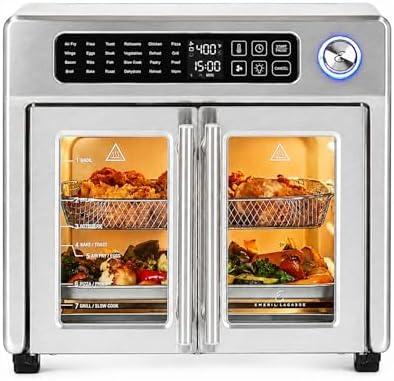
- A VERSATILE AIR FRYER AND MULTI-COOKER COMBO: Elevates practically any meal, from air frying quick after-school snacks t…
- PERFECTLY DONE TOAST: Oven turns off automatically when the toast count-down timer ends, no burnt toast! Indicator light…
- DUAL-SPEED FAN: Golden fried crisping at its finest with 360º superheated air circulation for your homemade cooking.
There are three main formats on the market, and each suits a different kind of cook.
Basket-Style Air Fryers
A single pull-out basket sits below a heating element and fan. This is the format most people picture when they hear “air fryer.” It’s compact, quick to preheat, and typically the easiest to clean, but it only cooks one dish at a time and usually requires shaking or flipping food partway through for even browning.
Dual-Basket Air Fryers
These use two separate baskets with independent temperature and time controls, so you can cook chicken in one side and vegetables in the other without flavor transfer, and have both finish at the same time. They take up more counter space than a single basket model and cost more, but they solve the “one dish is ready before the other” problem that comes up constantly with single-basket cooking.
Oven-Style Air Fryer Toaster Ovens
These look like a small countertop oven with a front door instead of a pull-out drawer, and usually include multiple wire racks. They offer the most flexibility — baking, broiling, dehydrating, toasting, and air frying in one appliance — and can often fit a small sheet pan or cake pan, which basket models can’t. The tradeoff is a larger footprint and, in many cases, a longer preheat time.
Style Comparison Table
| Style | Typical Capacity | Footprint | Cooking Flexibility | Ease of Cleaning | Ideal User | Major Advantage | Major Drawback |
|---|---|---|---|---|---|---|---|
| Basket-style | 2–6 qt | Small | Low–Moderate | Easiest | Singles, couples, small kitchens | Compact, fast, affordable | One dish at a time; needs shaking |
| Dual-basket | 6–10 qt combined | Medium–Large | High | Moderate | Families with mixed meal needs | Cook two foods at once | Bulkier; higher price |
| Oven-style | 8–26 qt (varies widely) | Large | Highest | More involved | Large families, bakers, multi-use buyers | Bakes, broils, holds multiple racks | Takes the most counter and storage space |
3. Don’t Judge an Air Fryer by Quart Capacity Alone
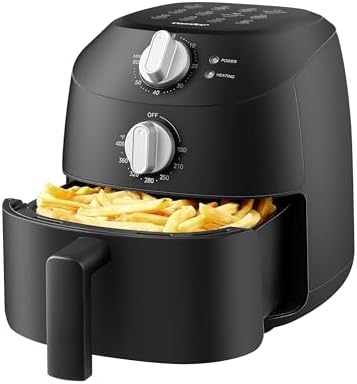
- MINIMAL OIL, MAXIMUM CRISPY RESULTS: Enjoy healthier meals with the COMFEE Air Fryer, which uses up to 90% less oil than…
- 12 COOKING OPTIONS FOR EVERY MEAL: The COMFEE Air Fryer lets you defrost frozen foods, make game-day favorites like frie…
- RAPID AIR CIRCULATION TECHNOLOGY: Featuring a 360-degree circulation hot air system to make the dishes you love in a hea…
Two air fryers can both claim “6 quarts” and cook very differently. What actually determines how much food you can cook well is the usable cooking surface — the shape and depth of the basket, not just its stated volume.
A tall, narrow basket may hold more liquid volume on paper, but it forces food into a deep pile instead of a single layer. Air fryers work by circulating hot air around food from multiple directions; when food is stacked instead of spread out, the air can’t reach every surface, so you get uneven browning and softer, less crispy results — even though the basket “held” more.
This is also why overcrowding is one of the most common performance complaints with air fryers. Piling in a full bag of frozen fries at once often produces steamed, pale results rather than the crisp texture shown in marketing photos, simply because there isn’t enough airflow around each piece. As Consumer Reports has found through repeated lab measurements, the labeled capacity and the usable capacity are frequently two different numbers, which is why judging a model on quarts alone can be misleading.
When comparing models, look for information on basket dimensions (width and depth) rather than volume alone, and consider whether the shape is wide and shallow (better airflow) or narrow and deep (more prone to overcrowding).
4. Measure Your Kitchen Counter Space Before Buying
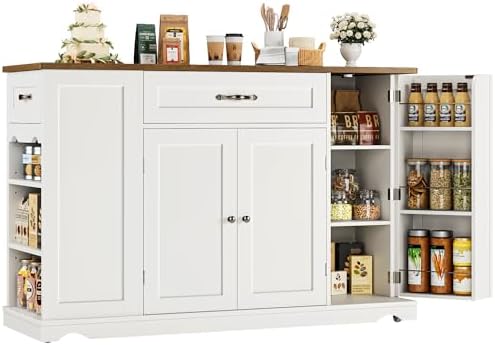
- ALL-IN-ONE SPACIOUS STORAGE: Corroborating two different-sized drawers for daily-used culinary tools like plates and sil…
- SMOOTH MOBILITY: This mobile island for kitchen stands on 5 smooth swivel casters, one of which is in the middle of the …
- USER-FRIENDLY DESIGN: Two shelves in the side open cabinet are adjustable, enabling you to customzie space for different…
This step gets skipped more often than any other, and it’s the reason so many air fryers end up returned or shoved in a cabinet. Before buying, measure:
- Width and depth of the footprint — and remember to add several inches of depth for a pull-out basket or a swing-open door.
- Height, including clearance above the unit — most air fryers vent hot air out of the top or back, so placing one directly under a cabinet can trap heat and, over time, damage the cabinet finish.
- Side clearance — leave a few inches on each side for airflow, especially with oven-style units that have side vents.
- Storage — if you don’t plan to leave it out permanently, check the weight and whether it will realistically fit in a cabinet or pantry shelf.
- Access to the controls — make sure the control panel won’t be blocked by an upper cabinet or a range hood when the unit sits on your counter.
If your kitchen is already tight on space, the same logic that applies to choosing between a compact and full-size blender applies here — see our comparison of immersion blenders vs. countertop blenders for a broader look at balancing appliance capability against available counter space.
5. Check Wattage and Power Requirements
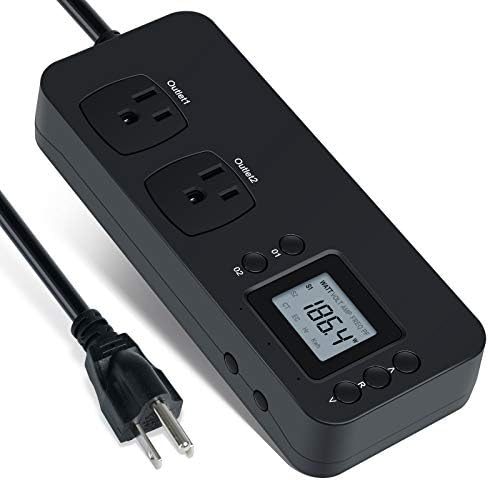
- NEW DESIGN: Our new electricity usage monitor with 2 outlets design can allow you monitor the power consumption of two e…
- POWER OFF MEMORY FUNCTION: With standard memory function, the CT and EC-KWH of electrical power consumption can be retai…
- SAFETY & OVERLOAD TIP: Full ABS flame retardant material housing, and equipped with 14AWG heavy duty extension cord, per…
Air fryer wattage typically ranges from about 800 watts on compact models to 1,800 watts on larger basket and oven-style units. In practical terms, higher wattage generally means the unit can reach and hold high temperatures faster, which matters most when you’re cooking a full basket rather than a small snack portion.
A few practical points:
- Standard US kitchen outlets are usually on a 15- or 20-amp, 120-volt circuit, which comfortably handles a single air fryer. Problems tend to show up when an air fryer shares a circuit with another high-draw appliance (like a microwave or toaster oven) running at the same time — this can trip a breaker.
- Wattage isn’t a direct measure of cooking quality. A well-designed 1,200-watt unit can outperform a poorly designed 1,700-watt one. Wattage affects heat-up speed and recovery time (how quickly the unit returns to temperature after you open the basket), not necessarily final crispiness.
- Larger capacity generally needs more wattage to heat the extra air volume evenly, so don’t assume a big-basket model at unusually low wattage will perform the same as a smaller, higher-wattage one.
Manufacturer wattage listings are a manufacturer specification, not an independently tested performance metric — treat them as one data point rather than the deciding factor.
6. Which Air Fryer Features Actually Matter?

- 𝘼𝙞𝙧 𝙁𝙧𝙮𝙚𝙧 𝙐𝙥𝙜𝙧𝙖𝙙𝙚: Innovative TurboBlaze Technology delivers a powerful 3600 rpm fan speed and temperatures up to 450℉, …
- 𝙃𝙚𝙖𝙩𝙞𝙣𝙜 𝙐𝙥𝙜𝙧𝙖𝙙𝙚: Cosori’s unique 5-fan speed system and precise 90°– 450°F temperature control deliver evenly cooked dis…
- 𝙋𝙁𝘼𝙎-𝙁𝙧𝙚𝙚 𝘾𝙚𝙧𝙖𝙢𝙞𝙘 𝙐𝙥𝙜𝙧𝙖𝙙𝙚: The basket and crisper tray feature a PFAS-free, nonstick ceramic coating for enhanced durabi…
Feature lists on air fryer packaging can make a $50 model and a $200 model look nearly identical. Here’s how to separate what actually changes your cooking experience from what’s mostly marketing.
Must-have features:
- Adjustable, reasonably accurate temperature control (ideally covering roughly 180°F to 400°F)
- A built-in timer with auto shut-off
- A basket or tray that’s dishwasher-safe or at minimum easy to hand-wash
- A stable, nonslip base and a handle that stays cool to the touch
Nice-to-have features:
- Cooking presets for common foods (useful for beginners, easy to ignore once you know your own settings)
- A shake/flip reminder partway through cooking
- A viewing window to check food without opening the basket and losing heat
- A “keep warm” function
Features that may not be worth paying extra for:
- App or Wi-Fi connectivity — convenient for some, but rarely changes cooking outcomes and is one more thing that can fail or become unsupported over time
- A built-in food probe — useful for large roasts, unnecessary for typical air fryer meals like fries, wings, or vegetables
- Elaborate touchscreen displays, which add cost without improving performance and can be harder to use with wet or greasy hands than simple dials or buttons
If you’re deciding between two similarly priced models, prioritize the must-have list first. A model with precise temperature control and an easy-to-clean basket will usually serve you better long-term than one with a longer feature list but mediocre build quality.
7. Cooking Performance: What Should You Expect?
Cooking performance varies by model, and manufacturer specifications don’t always predict how a unit performs in practice — this is an area where independent testing (like Consumer Reports’ lab evaluations) tends to be more reliable than marketing claims. That said, here’s what’s generally true across most well-designed air fryers:
- Crispiness depends heavily on food spacing (see Section 3) and preheating. Skipping preheat, especially in oven-style units, often leads to soggier results.
- Even cooking is improved by shaking or flipping food halfway through, particularly in basket-style models where the heating element sits above the food.
- Reheating is one of the strongest use cases for air fryers — food like pizza, fried leftovers, and roasted vegetables often comes out crisper than a microwave and faster than a conventional oven.
- Frozen foods (fries, nuggets, dumplings) tend to perform well since they’re designed for high-heat, dry cooking, similar to conventional frying.
- Chicken and meat cook well when pieces are similar in size and not overcrowded; thicker cuts may need a lower temperature and longer time to cook through without burning the exterior.
- Vegetables crisp up nicely with a light oil coating, but very wet vegetables (like fresh spinach) or very small pieces can dry out or blow around in the basket’s airflow.
- Baking works best in oven-style or larger basket models that can fit a small pan; results can vary more than a conventional oven since air fryers cook faster and hotter in a smaller cavity, so recipes often need adjusted times and temperatures.
8. Ease of Cleaning and Maintenance
Cleaning routines vary by design:
- Basket-style units are generally the easiest to clean — most baskets and trays are dishwasher-safe, and there are few crevices for grease to collect.
- Dual-basket models double your cleanup since there are two baskets and trays, though each individual piece is usually still dishwasher-safe.
- Oven-style units often have more surface area, multiple racks, and a crumb tray, which means more pieces to clean but also more even grease distribution rather than concentrated buildup in one small basket.
General maintenance tips that apply to nearly every model: wipe down the heating element area periodically (never submerge it), let the unit fully cool before cleaning, and avoid abrasive scrubbers on nonstick surfaces, which leads into the next section.
9. Basket Material and Nonstick Coatings
Most air fryer baskets use a nonstick coating, most commonly PTFE (the material used in traditional “Teflon” cookware) or a ceramic-based nonstick coating. This is a topic where it’s worth separating regulatory status from consumer debate rather than making a blanket safety claim.
The FDA authorizes specific PFAS-containing substances, including certain nonstick coatings, for use in food-contact applications, and states that current data indicate most of these uses do not present a known dietary exposure concern, with the exception of certain grease-proofing agents used in paper packaging, which manufacturers have since phased out. At the same time, consumer and environmental advocacy groups have raised ongoing questions about PFAS-family coatings more broadly, and that public debate is still active. Rather than making a claim about safety, the practical buying guidance is:
- If you’d prefer to avoid PTFE-based coatings entirely, ceramic-coated baskets are widely available, though they tend to lose their nonstick properties faster with heavy use and abrasive cleaning.
- Any nonstick coating — PTFE or ceramic — will degrade faster if scratched with metal utensils or scoured with abrasive pads. Use silicone or wooden tools and non-abrasive sponges to extend basket life.
- If a basket becomes visibly scratched, flaking, or peeling, replacing it (where available) is generally recommended regardless of coating type, since a compromised nonstick surface no longer performs as intended.
- Check whether the manufacturer sells replacement baskets separately before buying — this affects long-term cost and is covered further in the next section.
This guide isn’t making a health claim in either direction; it’s flagging that coating type is a legitimate factor to weigh based on your own comfort level, and that regulatory status and consumer advocacy positions on this topic don’t fully agree.
10. Warranty, Replacement Parts and Long-Term Value
Warranty length is a reasonable proxy for how confident a manufacturer is in their own build quality, though it’s not a guarantee of performance. Most air fryers in the budget-to-midrange bracket come with a 1-year limited warranty; some premium and oven-style models extend to 2–3 years.
Before buying, check:
- Whether replacement baskets, trays, or racks are sold separately. A basket that eventually wears out shouldn’t mean replacing the whole appliance, but not every manufacturer sells parts individually.
- What the warranty actually covers — some only cover manufacturing defects, not normal wear like a degraded nonstick coating.
- Availability of customer support and documentation. Manufacturer spec sheets and user manuals (usually available directly from the manufacturer’s website) are useful for confirming actual wattage, capacity, and safety certifications rather than relying on secondhand retail listings.
A slightly higher upfront cost on a model with accessible replacement parts and a longer warranty often works out cheaper over a few years than repeatedly replacing a budget unit.
11. How Much Should You Spend on an Air Fryer in 2026?
Price generally tracks capacity, build quality, and extra functionality, but spending more doesn’t automatically mean better cooking performance — it usually means more features and a larger cooking capacity.
| Budget Tier | Typical Price Range | What to Expect |
|---|---|---|
| Entry-level | ~$40–$70 | Compact basket model, 2–4 qt, basic dial or button controls, solid for 1–2 people |
| Mid-range | ~$80–$160 | 5–8 qt basket or dual-basket models, digital controls, presets, dishwasher-safe parts |
| Premium | ~$160–$300+ | Larger dual-basket or oven-style units, multiple racks, higher build quality, app connectivity, longer warranties |
At the entry level, expect fewer presets and a smaller capacity, but core cooking performance can still be solid — this tier is a reasonable, affordable air fryer option for individuals or couples who want the basics done well. At the premium tier, you’re mainly paying for capacity, versatility (baking, dehydrating, dual zones), and build quality rather than a fundamentally different cooking mechanism. Expensive air fryers aren’t universally “better” — they’re built for different use cases, so match the tier to your household size and cooking habits rather than assuming higher price equals higher quality for your specific needs.
12. Common Air Fryer Buying Mistakes to Avoid
- Buying based on advertised quart capacity alone, without checking basket shape or usable cooking surface.
- Underestimating counter space needs, especially depth for the pulled-out basket or opened door.
- Choosing a size too small for the household, leading to constant multi-batch cooking.
- Choosing a size too large, wasting both counter space and energy for regular single-portion cooking.
- Ignoring wattage requirements and assuming all models heat and recover at the same speed.
- Overpaying for features that don’t affect cooking outcomes, like elaborate app integrations.
- Not checking if replacement parts are available, which shortens the appliance’s realistic lifespan.
- Overcrowding the basket during cooking, which reduces crispiness regardless of how good the machine is.
- Skipping preheating, particularly with oven-style units, and being disappointed by soggier results.
- Using metal utensils or abrasive scrubbers on nonstick baskets, shortening coating lifespan.
- Not comparing warranty length and coverage before purchase, especially on premium-priced models.
For a more detailed breakdown of these and other pitfalls, see our full guide on common air fryer mistakes and how to avoid them.
13. Which Air Fryer Is Right for You?
- If you live alone → a compact 2–3.5 quart basket-style air fryer.
- If you have a family of 4 → a 5–6 quart basket model or a dual-basket unit if you often cook two different foods.
- If you have limited counter space → the smallest basket-style model that still meets your capacity needs; avoid oven-style units.
- If you cook two foods simultaneously → a dual-basket air fryer with independent controls.
- If you meal prep or batch cook → an 8-quart-plus model or an oven-style unit with multiple racks.
- If you bake frequently → an oven-style air fryer that can fit a small pan or tray.
- If you have a tight budget → an entry-level single-basket model in the 3–4 quart range; it covers the core use case without paying for extras you won’t use.
Air Fryer Buying Checklist
- Household size and typical portions confirmed
- Counter width, depth, height, and side clearance measured
- Basket shape checked (wide/shallow generally outperforms narrow/deep for the same quart size)
- Wattage matches capacity and your circuit setup
- Must-have features confirmed: accurate temperature control, timer, dishwasher-safe basket
- Nice-to-have features weighed against price difference
- Nonstick coating type identified (PTFE vs. ceramic) if this matters to you
- Warranty length and coverage reviewed
- Replacement basket/parts availability confirmed
- Budget tier matched to realistic household needs, not marketing claims
Frequently Asked Questions
What size air fryer should I buy? Base it on household size: 2–3 quarts for one person, 4–6 quarts for two to four people, and 6–8 quarts or more (or a dual-basket model) for five or more people or regular meal prep.
Is a 4-quart air fryer enough for two people? Generally yes for everyday meals, though keep in mind independent lab testing has found some models’ measured capacity runs smaller than the advertised number, so a “4-quart” model may cook closer to a true 3-quart capacity in practice.
Is a 6-quart air fryer good for a family of four? Yes, a 6-quart basket is typically enough for a family of four for most weeknight meals, though very food-heavy meals (a full chicken plus a large side) may still need two batches.
Is a dual-basket air fryer worth it? It’s worth it if you regularly cook two dishes that need different times or temperatures, since it lets you finish both at once. If you usually cook one dish at a time, a single larger basket may serve you just as well for less money and counter space.
Are expensive air fryers better? Not automatically. Higher price generally buys more capacity, more presets, and better build quality — not necessarily crispier or more evenly cooked food. A well-designed budget model can outperform a poorly designed expensive one.
How much wattage should an air fryer have? Most useful range is roughly 1,000–1,800 watts, with larger-capacity models generally needing the higher end of that range to heat evenly. Wattage affects heat-up and recovery speed more than it guarantees final food quality.
What features should I look for in an air fryer? Prioritize accurate temperature control, a reliable timer, and an easy-to-clean, dishwasher-safe basket. Treat presets, app connectivity, and food probes as optional conveniences rather than requirements.
Is an air fryer toaster oven better than a basket air fryer? Neither is universally better — an oven-style unit offers more versatility (baking, multiple racks, larger capacity) but takes up more counter space and often preheats more slowly. A basket-style model is more compact and typically faster for straightforward air frying.
How much counter space does an air fryer need? It varies by model, but plan for the stated footprint plus a few extra inches of depth for the basket or door to open fully, plus side and top clearance for ventilation — always check the manufacturer’s spec sheet for exact dimensions before buying.
What is the biggest mistake when buying an air fryer? Focusing on the advertised quart capacity without checking basket shape, counter space requirements, or how the household will actually use it — the three factors that most often lead to returns or an appliance that ends up unused.
This guide reflects manufacturer specifications and independently published testing data available at the time of writing. Specific capacity, wattage, and performance figures vary by model and brand — always check the manufacturer’s current spec sheet before purchasing.
Pingback: Best Coffee Makers for Home Use in 2026: Top-Rated Drip, Single-Serve, Programmable & Espresso Machines for Better Coffee Every Day - kitchencraftershub.com
Pingback: Best Rice Cookers for Families in 2026: Top Picks for Large Batches, Everyday Meals & Meal Prep - kitchencraftershub.com
Pingback: Cuisinart 14-Cup Food Processor Review - kitchencraftershub.com
Pingback: KitchenAid Artisan vs Professional Series: Which Stand Mixer Fits the Way You Bake? - kitchencraftershub.com