Buying a microwave for a small apartment isn’t the same as buying one for a full-size kitchen. In a small apartment, a few inches of extra depth can mean the door won’t fully open past a cabinet handle. A few extra pounds of exterior bulk can eat up counter space you were planning to use for a coffee maker or dish rack. And a microwave that hums or beeps loudly is a much bigger problem when your kitchen, living room, and sometimes bedroom are all the same space.
The biggest apartment-specific problems buyers run into are:
- Limited counter space, sometimes only 18–24 inches of usable depth
- Shallow counters that can’t fit a standard-depth microwave without overhanging the edge
- Small upper cabinets that limit height clearance
- Noise that carries through a studio or one-bedroom layout
- Little to no separate pantry or appliance storage
- The need for fast, no-fuss reheating rather than elaborate cooking
- Rental restrictions on permanent installations like over-the-range units
This guide is built around those specific constraints. Instead of just ranking microwaves by size or price, it walks through footprint, usable interior capacity, wattage, noise, and clearance requirements — the details that actually determine whether a microwave works in a small space — and then applies that framework to specific, currently available models.
Quick answer: For most small apartments, a 0.9–1.2 cu. ft. countertop microwave in the 900–1100 watt range hits the best balance of interior space, heating speed, and footprint. If your counter space is extremely tight, a 0.7 cu. ft. model saves several inches in every direction but limits you to smaller plates and bowls. If noise is your top concern because you live in a studio, a model with a soft-close door and a mute function is worth paying more for.
Quick Comparison: Best Microwaves for Small Apartments in 2026
| Microwave | Capacity | Wattage | Approx. Size (W x D x H) | Best For | Key Feature |
|---|---|---|---|---|---|
| Toshiba EM131A5C-BS | 1.2 cu. ft. | 1100W | ~20.5″ x 17.2″ x 12.8″ | Best overall balance | Smart humidity sensor cooking |
| COMFEE’ EM720CPL-PMB | 0.7 cu. ft. | 700W | ~17.3″ x 13″ x 10.2″ | Best budget pick | Mute function, child lock, low price |
| Magic Chef MCM770W | 0.7 cu. ft. | 700W | ~17.4″ x 13.2″ x 10.2″ | Smallest counter footprint | Compact dorm-friendly size |
| Panasonic NN-SN651B | 1.2 cu. ft. | 1200W | ~20.7″ x 15.8″ x 12.25″ | Higher-power reheating | Inverter technology for even heat |
| Breville Compact Wave Soft Close | 0.9 cu. ft. | 900W | ~19.1″ x 16.4″ x 11.5″ | Quiet apartment use | 80% quieter soft-close door |
| Panasonic HomeCHEF 4-in-1 (NN-CD87KS) | 1.2 cu. ft. | 1000W | ~22″ x 17.7″ x 13.5″ | Premium all-in-one | Air fry, convection, and broil in one unit |
Prices, availability, and exact specs can change, so always confirm current details on the product page before buying. Where a listing shows a model as discontinued at one retailer, check current Amazon availability, since retailers cycle stock at different times.
Best Microwaves for Small Apartments in 2026
Best Overall: Toshiba EM131A5C-BS (1.2 cu. ft., 1100W)

- 5-in-1 Microwave Oven: Use this essential countertop appliance for cooking in five functions: microwave, air fryer, comb…
- 10 Cooking Levels: Featuring a 900-watt output, this compact microwave has 7 auto menus, including settings for Beverage…
- Air Fry Presets: This small-but-mighty microwave has 11 preset air fry menus, including for cooking frozen French fries,…
Verdict: This is the model that shows up most consistently across independent testing for its combination of interior space, sensor cooking, and price. It’s a reasonable default pick if you don’t have a strong reason to choose something smaller or quieter.
Best for: Renters who want one microwave that handles both quick reheats and slightly larger meals without a big price jump.
Key specifications:
- Capacity: 1.2 cu. ft.
- Wattage: 1100W
- Turntable diameter: approximately 12.4 inches
- Controls: digital touchpad with a smart humidity/steam sensor and multiple preset menus
- Extras: mute function, ECO mode, child safety lock, easy-clean interior
Why it works in an apartment: A 12.4-inch turntable comfortably fits standard 10–11 inch dinner plates, which smaller 0.7 cu. ft. models often cannot. According to Toshiba’s official product specifications, this model includes six sensor-cook auto menus and a smart humidity sensor that automatically adjusts cooking time and power.
Pros:
- Interior fits large plates and mixing bowls
- Sensor cooking reduces guesswork on reheats
- Mute option for quieter operation
- Widely available at a moderate price point
Cons:
- Larger footprint than true “small counter” models
- Heating evenness has been described as inconsistent on some foods in third-party reviews
- Turntable size adds to the overall footprint even though the exterior isn’t huge
Who should buy it: Anyone who wants one microwave to cover most everyday tasks — reheating leftovers, cooking frozen meals, defrosting — without needing a second appliance.
Who should skip it: Anyone working with less than 18 inches of counter depth; look at the Magic Chef or COMFEE’ options instead.
[Check the current price on Amazon]
Best Budget Pick: COMFEE’ EM720CPL-PMB (0.7 cu. ft., 700W)
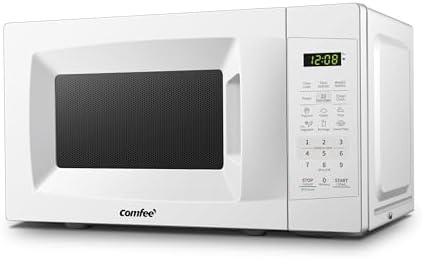
- Two-Step Child Lock Feature: For extra protection and to prevent misuse, all microwave oven manufacturers are asked to f…
- Mute Function: Turn off all the microwave beeps by pressing the sound on/off button for 3 seconds, which will bring you …
- Easy one-touch express cooking function with 1-6 minutes and +30 seconds functions, and two defrost settings (by weight …
Verdict: A straightforward, no-frills microwave built for dorms, small apartments, and secondary spaces like a home office. It won’t cook a Thanksgiving-sized casserole, but it covers reheating and basic cooking at a low price and a genuinely small footprint.
Best for: Students, single-person households, and anyone who mainly reheats leftovers or cooks frozen meals rather than doing hands-on microwave cooking.
Key specifications:
- Capacity: 0.7 cu. ft.
- Wattage: 700W
- Turntable diameter: approximately 10 inches
- Exterior dimensions: roughly 17.3″ W x 13″ D x 10.2″ H
- Extras: 11 power levels, mute function, child safety lock, ECO mode
Why it works in an apartment: At roughly 13 inches of depth, this is shallow enough to sit on counters that can’t accommodate full-size models. The mute function turns off all microwave beeps, and a child safety lock helps prevent accidental use, both of which matter more in compact living situations where the microwave sits close to shared living space.
Pros:
- Genuinely compact — fits narrow counters and small kitchen carts
- Mute and child lock included even at a low price
- Low upfront cost
- Simple one-touch presets for common foods
Cons:
- 700W means noticeably slower heating than 1000W+ models
- 10-inch turntable won’t fit large dinner plates
- Not built for cooking anything beyond reheating or basic defrosting
Who should buy it: Dorm residents, single renters, or anyone furnishing a small secondary kitchen space (like an office break area) on a tight budget.
Who should skip it: Households of two or more who regularly reheat full dinner plates or cook frozen entrees that need faster heating.
[See today’s availability on Amazon]
Best for the Smallest Counter Space: Magic Chef MCM770W (0.7 cu. ft., 700W)
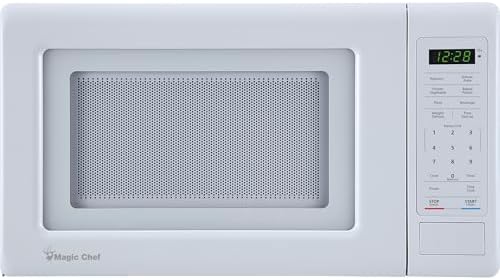
- Easy-to-use electronic controls with digital display
- Rotating glass turntable for even heat distribution
- 6 preprogrammed cooking modes for commonly microwaved foods
Verdict: Nearly identical in spec to the COMFEE’ model, but worth calling out separately because it’s one of the more commonly stocked “smallest footprint” options and comes in white, black, and stainless finishes, which matters when you’re trying to match a small kitchenette.
Best for: Buyers who need the smallest possible countertop microwave and are comfortable trading capacity for space savings.
Key specifications:
- Capacity: 0.7 cu. ft.
- Wattage: 700W
- Exterior dimensions: approximately 17.4″ W x 13.2″ D x 10.2″ H
- Controls: digital display with quick-set buttons for popcorn, dinner plate, baked potato, pizza, beverage, and frozen vegetables
- Extras: child control lock, auto defrost by weight or time, express cooking (1–6 minutes)
Why it works in an apartment: When every inch of depth matters — for example, on a counter that’s only 18–20 inches deep — a 13-inch-deep microwave leaves meaningfully more clearance in front of the door than a 16–17-inch-deep model does. This is the category where “compact” claims actually translate into a smaller physical footprint on the counter.
Pros:
- One of the shallower compact microwaves widely available
- Straightforward controls with minimal learning curve
- Available in multiple finishes for small-kitchen aesthetics
Cons:
- 700W heating speed is noticeably slower than 1000W+ models
- Small turntable limits plate and bowl size
- Basic feature set with no sensor cooking
Who should buy it: Anyone whose primary constraint is physical counter depth rather than cooking capability.
Who should skip it: Anyone who frequently reheats large portions or cooks for more than one or two people.
[Check the latest Amazon price]
Best Higher-Power Compact Microwave: Panasonic NN-SN651B (1.2 cu. ft., 1200W)

- NN-SN75LB
- AUTO AND SENSOR COOK – 20 preset smart cooking options including fresh and frozen entrees and vegetables, oatmeal, soup,…
- MINIMUM COUNTERTOP FOOTPRINT – Smart, Compact Design Occupies Less Space for Electronics and More for Interior Capacity:…
Verdict: If you want faster heating without stepping up to a bulky full-size microwave, this is the model most often recommended for combining higher wattage with a relatively compact interior, thanks to Panasonic’s inverter technology.
Best for: Renters who reheat food often throughout the day and don’t want to wait on a slower 700–900W unit.
Key specifications:
- Capacity: 1.2 cu. ft.
- Wattage: 1200W
- Turntable diameter: approximately 13.5 inches
- Exterior dimensions: approximately 20.7″ W x 15.8″ D x 12.25″ H
- Extras: inverter turbo defrost, genius sensor cooking, 10 power levels, keep-warm function
Why it works in an apartment: According to Panasonic’s official product page for this model, the inverter power unit is designed to devote less space to internal electronics and controls, which increases usable interior capacity relative to the exterior footprint compared with older conventional transformer-based designs. In practice, that means a microwave that heats faster without requiring a proportionally larger exterior shell.
Pros:
- 1200W significantly cuts reheating time versus 700–900W models
- Inverter technology helps prevent overcooked edges with underheated centers
- Large turntable accommodates bigger dishes
Cons:
- Retailer stock has been inconsistent — confirm current availability before ordering
- Larger exterior dimensions than budget compact models
- Higher price point than basic 0.7 cu. ft. units
Who should buy it: Anyone prioritizing heating speed and even reheating over the smallest possible footprint.
Who should skip it: Buyers with very limited counter depth, since this unit’s footprint is closer to a mid-size microwave than a true compact.
[Check current price and availability]
Best Quiet Microwave for Apartments: Breville Compact Wave Soft Close (0.9 cu. ft., 900W)

- Two-step Child Lock Feature: For extra protection and prevent misuse, all microwave oven manufacturers are asked to foll…
- Mute Function: Turn off all the microwave beeps by pressing the sound on/off button for 3 seconds, for a quiet cooking e…
- Easy one-touch express cooking function with 1-6 minutes and +30 seconds functions, and two defrost settings (by weight …
Verdict: Built specifically around reducing noise, which makes it a strong pick for studio apartments or anyone sharing thin walls with roommates or neighbors. This model has also been named a top pick in America’s Test Kitchen’s ongoing microwave testing for its ease of use and intuitive controls.
Best for: Studio apartments, late-night reheating, and anyone sensitive to appliance noise in a small living space.
Key specifications:
- Capacity: 0.9 cu. ft. (25L)
- Wattage: 900W
- Exterior dimensions: approximately 19.1″ W x 16.4″ D x 11.5″ H
- Extras: soft-close door, mute button, child lock, +30 second instant start
Why it works in an apartment: The soft-close door system and mute button are specifically engineered to reduce noise during everyday use, and the door itself is designed to be roughly 80% quieter than a standard microwave door. In a studio apartment where the kitchen, living, and sleeping areas share the same room, slamming doors and loud end-of-cycle beeping are a bigger annoyance than they would be in a larger home, so this kind of engineering has a real practical payoff.
Pros:
- Meaningfully quieter door mechanism than standard hinged designs
- Mute button silences beeps entirely
- Clean, simple control layout praised in independent testing
Cons:
- No dedicated countdown timer separate from the cook timer, according to some retailer buyer Q&A
- Higher price than basic compact models
- 900W is mid-range, not the fastest heating option available
Who should buy it: Studio-apartment residents, night-shift workers reheating food at odd hours, or anyone who shares thin walls with neighbors.
Who should skip it: Budget-focused buyers who don’t mind normal beeping and door noise.
[See today’s price on Amazon]
Best Premium Compact Microwave: Panasonic HomeCHEF 4-in-1 (NN-CD87KS, 1.2 cu. ft., 1000W)
- 5-in-1 Microwave Oven: Use this essential countertop appliance for cooking in five functions: microwave, air fryer, comb…
- 10 Cooking Levels: Featuring a 900-watt output, this compact microwave has 7 auto menus, including settings for Beverage…
- Air Fry Presets: This small-but-mighty microwave has 11 preset air fry menus, including for cooking frozen French fries,…
Verdict: This isn’t a pure “small microwave” in the minimalist sense — it’s a multi-function unit that replaces a microwave, air fryer, and small convection oven with a single appliance, which can be a genuine space-saver in a kitchen too small for three separate countertop gadgets.
Best for: Apartment dwellers who want to consolidate appliances rather than run a microwave, air fryer, and toaster oven side by side.
Key specifications:
- Capacity: 1.2 cu. ft.
- Wattage: 1000W (microwave function)
- Exterior dimensions: approximately 22″ W x 17.7″ D x 13.5″ H
- Cooking modes: microwave, air fry, convection bake, broil, plus combination modes
- Extras: inverter technology, genius sensor cooking, 14.2-inch turntable
Why it works in an apartment: According to Panasonic’s product specifications, this unit combines a microwave, air fryer, broiler, and convection oven into one compact appliance, which is a meaningful space trade-off if your kitchen doesn’t have room for separate devices. If you’re weighing whether a combination unit like this makes more sense than a standalone air fryer, our guide to the best air fryers for home use and our breakdown of an air fryer vs convection oven can help you decide which setup actually fits your cooking habits.
Pros:
- Replaces multiple appliances, which can be a net space saver
- Genius sensor cooking works well for popcorn and reheating, according to independent reviews
- Even heating performance across the turntable in third-party testing
Cons:
- Largest exterior footprint of the models in this guide
- Control interface has a learning curve due to the number of modes
- Higher price point reflects the added functionality
Who should buy it: Anyone replacing multiple small appliances with one unit to save counter and cabinet space overall.
Who should skip it: Anyone who only needs basic reheating — the added functionality isn’t worth the larger footprint or price if you won’t use it.
[Check the current price on Amazon]
How to Choose a Microwave for a Small Apartment
Choosing the right microwave for a small space comes down to measuring correctly and prioritizing the right specs — not just picking the smallest box you can find.
- Measure your available counter space first. Measure width, depth, and height of the exact spot the microwave will sit, not just the general counter area.
- Check the microwave’s exterior width against your available space, and leave at least an inch or two of buffer on each side.
- Check exterior depth carefully. This is the dimension most often ignored, and it’s the one that determines whether the microwave overhangs the counter edge or blocks a walkway.
- Check height, especially if the microwave will sit under a cabinet — you need clearance for both the unit itself and for opening the door without hitting the cabinet above.
- Leave ventilation clearance. Most manufacturers specify a few inches of space around the vents (commonly on the back and sides) to prevent overheating.
- Check door-opening clearance, including which direction the door swings and how much space it needs to fully open — this matters most in corner placements or next to a wall.
- Choose the right capacity for how you actually cook, not the largest capacity available. See the size guide below.
- Choose appropriate wattage for your typical use — faster reheating versus a smaller, lower-power unit.
- Consider noise, including the fan, the beep volume, and the sound of the door opening and closing, especially in a studio.
- Decide whether sensor cooking is worth it. It’s convenient but not essential if you mostly use manual time/power settings anyway.
- Look for a mute function if you plan to use the microwave at odd hours or live in a space with thin walls.
- Check child-lock requirements if children or curious pets are ever in the space.
- Consider cleaning and interior design — smooth, coated interiors are easier to wipe down than textured ones.
- Consider your typical plate and bowl sizes. A microwave with a small turntable may not fit your everyday dinnerware.
- Decide whether an over-the-range model makes more sense than a countertop unit — covered in detail below.
Measurement Checklist
Before you buy, physically measure and write down:
- Available counter width (in inches)
- Available counter depth (in inches)
- Height from counter to the bottom of any upper cabinet
- Distance from the wall or corner to any obstruction the door would swing into
- Distance from the nearest outlet to the counter spot (cord length matters)
- Your largest everyday plate or bowl diameter
Small Apartment Size Guide
| Apartment / User Type | Recommended Capacity | Recommended Wattage | What to Prioritize |
|---|---|---|---|
| Dorm room | 0.5–0.7 cu. ft. | 700W | Smallest footprint, low price, basic reheating |
| Studio apartment | 0.7–1.0 cu. ft. | 700–1000W | Quiet operation, small footprint |
| Single person | 0.7–1.0 cu. ft. | 700–1000W | Everyday reheating speed, easy cleaning |
| Couple | 0.9–1.2 cu. ft. | 900–1100W | Turntable size for two plates, faster heating |
| Small family | 1.1–1.5 cu. ft. | 1000–1200W | Larger interior, faster heating for bigger portions |
| Rental kitchen | 0.7–1.2 cu. ft. | 700–1100W | Countertop-only design, no installation required |
| Very shallow counter | 0.7 cu. ft. | 700–900W | Exterior depth over interior capacity |
These are practical starting points, not rigid rules — someone who mostly reheats coffee and single portions can be comfortable with a 0.7 cu. ft. unit even as a couple, while someone who microwaves large casserole dishes solo may prefer a 1.1 cu. ft. model regardless of household size.
0.7 cu. ft. vs 0.9 cu. ft. vs 1.0–1.1+ cu. ft.
- 0.7 cu. ft. works well for a single person, a dorm room, or anyone mainly reheating mugs, small plates, and single-serving containers. It struggles with large dinner plates or wide mixing bowls.
- 0.9 cu. ft. is a reasonable middle ground for a studio apartment or a couple who don’t cook large portions in the microwave. It typically fits a standard dinner plate with a little room to spare.
- 1.0–1.1+ cu. ft. suits couples or small families who regularly reheat full dinner plates, cook frozen entrees, or use larger casserole dishes. It’s also the better choice if you frequently use big mixing bowls for melting or softening ingredients.
Wattage Explained Practically
Wattage affects how fast a microwave heats food, but it isn’t the only factor in real-world performance — turntable size, sensor accuracy, and even internal cavity shape all affect results too.
- 700W: Noticeably slower. A task that takes 90 seconds at 1000W might take over two minutes at 700W. Fine for basic reheating if you’re not in a hurry.
- 900W: A practical middle ground for most single people and couples — fast enough for daily use without a big jump in price or size.
- 1000W: A common sweet spot; fast enough for frozen meals and larger portions without requiring a full-size microwave body.
- 1100W: Slightly faster still, often paired with sensor cooking features that adjust time automatically.
- 1200W: The fastest tier in the compact category, useful if you reheat food frequently throughout the day and want to minimize wait time.
Don’t choose a microwave on wattage alone. A 1200W model with an inconsistent sensor or an oddly shaped interior can still underperform a well-designed 900W unit for certain foods, according to independent testing sources like RTINGS’ small microwave testing and This Old House’s small microwave buying guide. Wattage is a helpful shorthand, not a guarantee of quality.
Countertop Footprint vs. Usable Cooking Space
Two microwaves with nearly identical exterior dimensions can have meaningfully different interior capacities. This comes down to how much space the manufacturer devotes to the magnetron, control panel, and insulation versus the actual cooking cavity.
This is exactly why inverter-based models like the Panasonic NN-SN651B are worth considering: the compact design of an inverter power unit devotes less space to electronics and controls, leaving more of the exterior footprint available as usable interior capacity. When comparing two microwaves of similar external size, check the published interior capacity (in cubic feet) and turntable diameter rather than assuming they’re interchangeable just because they look similar on a spec sheet.
Noise Matters in Apartments
Noise is one of the most overlooked factors in small-space microwave shopping, and it shows up in several distinct ways:
- Fan and motor noise during operation, which can be more noticeable in a quiet studio than in a larger house
- End-of-cycle beeping, which can be jarring late at night or early in the morning
- Mute functions, which let you turn off beeping entirely — increasingly common even on budget models
- Door-closing noise, which ranges from a light click to a heavier metallic clang depending on the hinge design
If you live in a studio, work irregular hours, or share thin walls with neighbors, prioritize models with a mute button and, ideally, a soft-close door design like the Breville Compact Wave Soft Close.
Apartment-Friendly Features Worth Prioritizing
- Sensor cooking: Automatically adjusts time and power based on steam output — useful for popcorn and reheating but not essential for simple manual heating.
- Quick-start / +30 seconds: Lets you add time with one button press instead of resetting the whole cycle — genuinely useful for daily reheating.
- Mute button: Turns off beeps for quieter operation, valuable in shared or small living spaces.
- Child lock: Prevents accidental operation, useful if kids, roommates, or pets are around.
- Easy-clean interior: A smooth, non-textured interior coating wipes down faster than a ribbed or painted one.
- Interior light: Helps you see food through the door without opening it.
- Defrost settings: Weight-based or time-based defrost programs save guesswork.
- Preset cooking menus: Handy for common foods but not a dealbreaker if you’re comfortable setting time manually.
- Simple controls: A straightforward touchpad or dial beats a confusing multi-mode interface for everyday reheating tasks.
- Soft-close door: Reduces noise and impact on the hinge over time, though it’s currently limited to a small number of models.
Door and Counter Clearance
Before finalizing a purchase, check:
- Door-opening direction — most countertop microwaves open left to right, which matters if you’re placing the unit near a wall or corner
- Handle clearance — make sure there’s enough room to grip and pull the handle comfortably
- Side clearance — leave a few inches on each side for ventilation, per manufacturer guidance
- Rear clearance — most units need a small air gap behind them; check the specific model’s manual
- Height under cabinets — measure from the counter to the cabinet bottom, then compare to the microwave’s height plus a few inches of buffer
- Front access — confirm you can fully open the door without it hitting an island, chair, or adjacent appliance
Microwave vs. Over-the-Range Microwave for a Small Apartment
| Factor | Countertop Microwave | Over-the-Range (OTR) Microwave |
|---|---|---|
| Counter space | Uses counter space | Frees up counter space entirely |
| Installation | Plug-and-use, no installation | Requires mounting hardware and often electrical/venting work |
| Cost | Generally lower upfront cost | Higher cost including installation |
| Portability | Fully portable, moves with you | Permanently installed, stays with the unit |
| Ventilation | Uses its own small internal vents | Can double as a range hood vent |
| Rental friendliness | Ideal for renters — no permanent changes | Often not allowed or not practical in rentals |
| Capacity | Wide range, 0.5–1.5+ cu. ft. | Typically larger, 1.5–2+ cu. ft. |
| Convenience | Easy to relocate or replace | Convenient overhead access if already installed |
| Best use case | Renters, apartments, dorms | Homeowners replacing an existing OTR unit |
For most renters and small-apartment residents, a countertop microwave is the more practical choice. Over-the-range units typically require permanent mounting to a wall stud and often tie into existing range-hood wiring or ductwork — changes most landlords won’t permit and that don’t make sense for a temporary living situation. If you’re in a rental with an existing OTR unit that stopped working, replacing it usually requires either an electrician or a very similar replacement model that matches the existing mounting bracket, so measure carefully before buying a replacement.
Many of these same trade-offs come up with other compact kitchen appliances — our guide on how to choose the right air fryer covers a similar footprint-versus-capacity balancing act if you’re furnishing a small kitchen from scratch.
Common Microwave Buying Mistakes in Small Apartments
- Buying based only on cubic feet. Two microwaves with the same capacity can have very different exterior footprints depending on design efficiency.
- Ignoring exterior depth. Width gets most of the attention, but depth is what usually determines whether a microwave fits your specific counter.
- Forgetting door clearance. A microwave that fits the counter perfectly can still be unusable if the door can’t fully open.
- Ignoring ventilation space. Pushing a microwave flush against a wall or cabinet can cause overheating and shorten its lifespan.
- Buying more wattage than your outlet setup comfortably supports. Higher-wattage microwaves draw more current; if you’re on an older circuit shared with other appliances, check your setup rather than assuming a higher-wattage unit is automatically fine.
- Ignoring noise. A loud fan or beep is a bigger daily annoyance in a small apartment than in a larger home.
- Assuming “compact” means every dimension is small. Some “compact” microwaves are shallow but tall, or narrow but deep — check all three dimensions, not just one.
- Choosing features you’ll never use. Paying extra for convection, air fry, or Wi-Fi connectivity only makes sense if you’ll actually use those functions.
- Forgetting plate size. A microwave with a small turntable may not fit your everyday dinnerware, forcing you to remove the turntable or use smaller dishes.
- Ignoring cleaning requirements. Textured or ridged interiors are harder to wipe down than smooth, coated ones.
- Buying an OTR microwave without checking installation requirements. OTR units often require matching an existing mounting bracket or hiring an electrician — not a simple swap in most rentals.
If you’re also rethinking other small-kitchen appliances, our roundups of common air fryer mistakes and best coffee makers for home use cover similar space-and-feature trade-offs.
Apartment-Specific Scenarios
Best microwave for a studio apartment: Prioritize noise reduction and a small footprint. The Breville Compact Wave Soft Close is worth the extra cost specifically because the soft-close door and mute button matter more when your kitchen, living room, and bedroom share one space.
Best microwave for a dorm room: Prioritize the smallest footprint and lowest price. The Magic Chef MCM770W or COMFEE’ EM720CPL-PMB both fit easily into typical dorm-room storage and mini-kitchen setups.
Best microwave for a couple: Prioritize turntable size and moderate wattage. A 0.9–1.2 cu. ft. model like the Toshiba EM131A5C-BS or Panasonic NN-SN651B comfortably fits two dinner plates’ worth of reheating needs.
Best microwave for a very small countertop: Prioritize exterior depth above all else. Look specifically at published depth measurements — the Magic Chef and COMFEE’ models both run around 13 inches deep, several inches shallower than mid-size units.
Best microwave for a rental apartment: Prioritize a countertop design over an OTR unit, since countertop models require zero permanent installation and move with you when your lease ends.
Best microwave for late-night or quiet use: Prioritize a mute function and, if your budget allows, a soft-close door. This is the specific use case the Breville Compact Wave Soft Close was designed around.
Best microwave for reheating leftovers: Prioritize wattage and turntable size over extra features. A straightforward 1000–1200W model with a full-size turntable, like the Toshiba EM131A5C-BS or Panasonic NN-SN651B, will reheat full plates faster than a lower-wattage compact unit.
If your small kitchen also needs a compact way to prep food beyond the microwave, our guides on the best air fryers for home use, budget air fryers under $100, and best single-serve coffee makers cover the other appliances that tend to compete for the same limited counter space.
Frequently Asked Questions
What size microwave is best for a small apartment? For most single people or couples, 0.7–1.2 cu. ft. is the practical range. Dorm rooms and very tight counters often do best with 0.7 cu. ft., while couples and light cooks tend to prefer 0.9–1.2 cu. ft.
What is the smallest useful microwave? Most usable countertop microwaves start around 0.5–0.7 cu. ft. Below that, interior space becomes too limited for a standard dinner plate or mug.
Is a 0.7 cu. ft. microwave big enough? For reheating single portions, mugs, and smaller plates, yes. For full dinner plates, large bowls, or family-sized portions, it’s often too small.
Is 700 watts enough for an apartment microwave? It’s enough for basic reheating and defrosting, but heating times will be noticeably longer than a 1000W+ model. It works well for single-person, low-frequency use.
Is 1000 watts better than 700 watts? For most daily use, yes — 1000W heats significantly faster. Whether it’s worth the size or price difference depends on how often you use the microwave and how impatient you are for reheated food.
How much ventilation space does a microwave need? This varies by model, but most manufacturers recommend a few inches of clearance on the back and sides. Always check the specific model’s installation instructions rather than assuming a standard clearance applies.
Can a microwave fit under a kitchen cabinet? Yes, as long as you measure the vertical clearance between the counter and the cabinet bottom and compare it to the microwave’s height plus a small buffer for airflow and door operation.
Are countertop microwaves better for renters? Generally yes. They require no permanent installation, move easily between apartments, and avoid the wiring or mounting changes that over-the-range units often require.
Are small microwaves noisy? Noise varies by model regardless of size. Some compact microwaves include mute functions and quieter door designs, while others use standard beeping and hinges. Check for a mute button and, if noise is a priority, look for a soft-close door.
Should I buy a microwave with sensor cooking? It’s a convenience feature, not a necessity. Sensor cooking automatically adjusts time and power based on steam output, which is helpful for popcorn and reheating but not essential if you’re comfortable setting time manually.
Is an over-the-range microwave better for a small apartment? Usually not for renters, since OTR units require permanent mounting and often ventilation work. Countertop microwaves are more practical for most apartment situations.
What should I measure before buying a compact microwave? Counter width, counter depth, height to any upper cabinet, door-swing clearance, distance to the nearest outlet, and the diameter of your largest everyday plate or bowl.
Final Verdict: Which Microwave Is Best for a Small Apartment?
There isn’t one universally “best” microwave for every small apartment — the right pick depends on which constraint matters most to you.
- For most apartment users, a 1.0–1.2 cu. ft. model in the 1000–1100W range, like the Toshiba EM131A5C-BS, offers the best overall balance of interior space, heating speed, and price.
- For the tightest spaces, the Magic Chef MCM770W or COMFEE’ EM720CPL-PMB shave several inches off exterior depth, which matters more than any other spec when counter space is genuinely limited.
- For budget buyers, the COMFEE’ EM720CPL-PMB delivers the core features — mute function, child lock, basic presets — at one of the lowest price points in this category.
- For studio apartments where noise carries through the whole living space, the Breville Compact Wave Soft Close is worth the added cost specifically for its soft-close door and mute button.
- For quiet operation in general, prioritize any model with a dedicated mute function over one without it, regardless of price tier.
- For higher-power needs, the Panasonic NN-SN651B’s inverter technology delivers faster, more even heating without requiring a full-size microwave body — just confirm current stock before ordering.
Whichever model you choose, the measurement checklist above matters more than any single spec on the list. A microwave with excellent reviews is still the wrong choice if it doesn’t fit your counter, blocks your cabinet doors, or can’t fully open next to a wall.
This article contains Amazon affiliate links. As an Amazon Associate, KitchenCraftersHub may earn from qualifying purchases at no additional cost to you. Prices and availability are subject to change.
Pingback: Countertop Microwave vs Built-In Microwave: Which Is Right for Your Kitchen in 2026? - kitchencraftershub.com