Research current as of October 2026. This post contains affiliate links, and as an Amazon Associate we earn from qualifying purchases. That never changes which products we recommend.
The best food processors for home cooks do a few jobs well: chopping an onion without leaving chunks, shredding a block of cheese in seconds, slicing potatoes evenly, and pulling pie or pizza dough together. Many “best food processor” lists never explain why one model beats another, or which features are worth paying for.
We haven’t hands-on tested these machines, and this guide doesn’t pretend we have. We compared testing from America’s Test Kitchen, Tom’s Guide, and Food Network with manufacturer specifications. Then we matched each model to the kind of cook it suits. When a result comes from a publication’s testing, we say so. When a spec comes from the manufacturer, we say that too.
Quick Answer: Best Food Processors for Home Cooks
- Best for most home cooks: Cuisinart Custom 14 (DFP-14BCNY). It topped America’s Test Kitchen’s 2026 rankings and was Tom’s Guide’s best overall pick.
- Best full-size value: Cuisinart Pro Custom 11 (DLC-8SY). America’s Test Kitchen named it its Best Buy.
- Best premium: Breville Sous Chef 16 (BFP810). It’s large, powerful, and loaded with attachments, and it costs and weighs accordingly.
- Best for small kitchens that still want attachments: Breville Paradice 9. All its blades and discs store inside the bowl.
- Best for slicing: KitchenAid 13-Cup (KFP1318). Tom’s Guide praised its externally adjustable slicing disc, though America’s Test Kitchen had reservations.
- Best budget food processor: Hamilton Beach 10-Cup Bowl Scraper (70730 series). It’s inexpensive and fast in Tom’s Guide’s tests, but loud.
Comparison Table
| Product | Best For | Capacity | Motor (manufacturer-listed) | Key Feature | Approx. Price* |
|---|---|---|---|---|---|
| Cuisinart Custom 14 (DFP-14BCNY) | Most home cooks, big batches, dough | 14 cups | 720W | Extra-large feed tube; blades store in bowl | ~$245–$320 |
| Cuisinart Pro Custom 11 (DLC-8SY) | Full-size performance for less | 11 cups | 625W | Two slicing discs plus a flat lid | ~$200–$220 |
| Breville Sous Chef 16 (BFP810) | Premium, attachment variety | 16 cups + 2.5-cup mini bowl | 1450W | 24-setting adjustable slicer, French fry disc | ~$500 |
| Breville Paradice 9 | Small kitchens, dicing | 9 cups | 625W | On-board storage; includes 12 mm dicing kit | ~$400 |
| KitchenAid 13-Cup (KFP1318) | Slicing | 13 cups | 500W | Externally adjustable slicing lever | ~$180–$230 |
| Hamilton Beach 10-Cup Bowl Scraper (70730) | Budget buyers | 10 cups | 450W | Built-in bowl scraper | ~$50–$70 |
Prices are approximate retailer listings gathered during 2026 research. They change often, so check current prices before you buy.
Individual Product Reviews
1. Cuisinart Custom 14 (DFP-14BCNY): Best for Most Home Cooks

- SUPERIOR FUNCTION: The Cuisinart Food Processor with 720-watt motor functions as a vegetable chopper, blender, and food …
- MUST-HAVE FEATURES: The 14-cup food chopper has “on” and “off/pulse” buttons with an extra-large feed tube with bowl sle…
- INCLUDED ACCESSORIES: This food processor comes with dishwasher-safe parts including a stainless steel standard slicing …
Who it’s for: Cooks who want one dependable, full-size machine for chopping, shredding, slicing, and dough, without a pile of attachments.
Key specifications (Cuisinart and retailer listings):
- 14-cup work bowl
- 720-watt motor
- Extra-large feed tube with large and small pushers
- Standard slicing disc (4 mm), medium shredding disc, chopping/mixing blade, detachable disc stem, spatula
- 3-year limited warranty on the unit, plus a 5-year motor warranty
- Dishwasher-safe parts except the motor base
- About 11″ × 7.9″ × 14.8″
What it does well: America’s Test Kitchen named it its top food processor. It praised the power, precision, and compact shape, and noted that all three blades store inside the bowl, so there’s no accessory box to manage. Tom’s Guide also ranked it best overall. Its testers measured about 65.2 dB during use, much quieter than several rivals, and reported it sliced a whole russet potato in two seconds and shredded cheddar in 10. Both publications reported it handled heavy dough well. America’s Test Kitchen’s double batch of sticky pizza dough was a deliberate stress test.
Important limitations:
- Tom’s Guide notes it has only one power setting.
- It’s heavy.
- America’s Test Kitchen found that a redesigned chopping blade sits slightly higher than before. In its test, the machine couldn’t emulsify a single batch of mayonnaise, though a double batch worked.
- The US model doesn’t list a mini bowl.
Best uses: Large-batch chopping, grating pounds of cheese or vegetables, pie crust, pizza dough, and pesto.
Value considerations: The list price is often around $320, but retailers frequently discount it. The 14-cup capacity is more than a two-person household needs.
Testing attribution: Tom’s Guide and America’s Test Kitchen. See Tom’s Guide’s full food processor testing for its methodology and noise measurements.
2. Cuisinart Pro Custom 11 (DLC-8SY): Best Full-Size Value

- Powerful Food Processor: This must-have Cuisinart Food Processor delivers reliable performance with durable design for e…
- 11-Cup Food Processor: Our 11-cup food processor offers the perfect size for meal prep, whether in everyday eating or en…
- Multi-Functional: Use this Cuisinart food chopper for everything from slicing vegetables to pureeing sauces. This elect…
Who it’s for: Cooks who want most of the Custom 14’s performance in a smaller package.
Key specifications (America’s Test Kitchen and retailer listings):
- 11-cup bowl
- 625-watt motor
- Thin (2 mm) and medium (4 mm) slicing discs, a shredding disc, and a chopping/mixing blade
- Compact flat lid with no feed tube
- 3-year limited warranty on the unit, plus a 5-year motor warranty
- Top-rack dishwasher-safe, per America’s Test Kitchen
What it does well: America’s Test Kitchen called it a Best Buy. It said the machine aced slicing, dicing, and chopping, and that it processed a double batch of pizza dough using 4 cups of flour. The flat lid is easy to clean for jobs where you won’t add ingredients mid-process, such as salsa or pie dough. Its blade also sits low enough to handle a single batch of mayonnaise.
Important limitations:
- It’s slightly less powerful than the 14-cup model, and its maximum liquid fill is 2.25 cups versus 3.
- The pusher is attached to an outer sleeve and can’t be removed. America’s Test Kitchen found that a safety feature, but one that makes cleaning a bit fussier.
Best uses: Everyday chopping, slicing, shredding, doughs, and sauces for households of two to four.
Value considerations: At roughly $200 to $220, it’s often the most sensible full-size buy. Color variants carry different model numbers (such as DLC-8SBCY), so check the specs.
3. Breville Sous Chef 16 (BFP810): Best Premium Food Processor

- The Breville Sous Chef 16 food processor is where precision and consistent size are the keys to beautiful presentation, …
- RECIPES FOR HOME AND KITCHEN: Breville+ opens a world of instant mastery with over 1000 guided recipes, live and on-dema…
- THE CHEF’S ARMORY OF PRECISION: Slice, shred, French fry, mince and purée with your very own chef’s armory; Includes a 2…
Who it’s for: Serious cooks with counter or cabinet space who will use extra attachments regularly.
Key specifications (Breville and America’s Test Kitchen):
- 16-cup bowl plus a 2.5-cup mini bowl
- 1450-watt induction motor
- 5.5-inch feed chute
- 24-size adjustable slicer, reversible shredding disc, French fry disc, micro-serrated S-blade, dough blade, mini blade, and storage case
- 2-year limited warranty, plus a 30-year limited motor warranty
- Dicing attachment sold separately
- Base weighs about 15 pounds (America’s Test Kitchen)
Details are on Breville’s official Sous Chef 16 page.
What it does well: America’s Test Kitchen’s “Upgrade Pick” shredded, sliced, and chopped quickly and uniformly with minimal waste. It made smooth, elastic pizza dough with no motor struggle. Testers liked the count-up timer, the short, responsive pulse, and clear alignment marks. Its liquid maximum is 5 cups, the most of the top picks.
Important limitations:
- America’s Test Kitchen called the multi-part blades “a bit annoying to assemble.” The lid has nooks that need detail cleaning, and part labels in the box don’t match the manual.
- It’s tall and heavy, and the accessory case needs storage. Food Network’s testers noted the line takes up a lot of space.
- The bowl and lid are better hand-washed.
- Breville’s older Sous Chef 16 Pro (BFP800 series) appears as no longer offered on its Canadian site. Online reviews may describe older versions, so match the model number.
Best uses: Big meal prep, uniform slices at set thicknesses, french-fry cuts, and small jobs in the mini bowl.
Value considerations: At about $500, it’s a purchase for cooks who will use the extras. America’s Test Kitchen said the basics are done well by far cheaper machines.
4. Breville Paradice 9: Best for Small Kitchens and Dicing

- The Breville Paradice 9 food processor is where precision and performance meet compact design with an onboard storage ca…
- RECIPES FOR HOME AND KITCHEN: Breville+ opens a world of instant mastery with over 1000 guided recipes, live and on-dema…
- ONBOARD STORAGE SOLUTION: Compact food processor for small kitchens; Easy-to-use integrated storage caddy holds dicing k…
Who it’s for: Cooks who want attachments, including dicing, without a big storage box.
Key specifications (Breville and US retailer listings):
- 9-cup bowl
- 625-watt motor in US listings (an Australian listing shows 605W)
- Reversible shredder, adjustable slicer, dough blade, S-blade, and a 12 mm dicing kit
- Onboard storage caddy inside the bowl
- 2-year limited warranty, plus a 30-year motor warranty
What it does well: Tom’s Guide named it the most versatile of the processors it tested, praising the space-saving storage and build quality. Its testers reported it turned dried sourdough into fine breadcrumbs and chopped cauliflower into rice without making mush. They also said it handled a large amount of cabbage for slaw in under a minute. They called the dicing attachment “a rarity at this size.”
Important limitations:
- Tom’s Guide found food can get stuck in the dicing attachment, which takes more effort to clean than simpler blades.
- Nine cups is limited for large batches or double-batch dough.
- It’s expensive for its capacity.
Best uses: Small and medium households that want precise cuts and tidy storage.
Value considerations: At around $400, you’re paying for design and the dicing kit. If you don’t dice often, a Cuisinart is better value.
5. KitchenAid 13-Cup (KFP1318): Best for Slicing

- All-in-one storage solution to store all blades and discs directly in the in-bowl storage caddy
- Easily adjust slicing thickness with the externally adjustable Exact Slice disc, from thick to thin
- Snap and Go, easy clean work bowl for easy set up with the twist-free, one-click bowl assembly and latched lid -add warm…
Who it’s for: Cooks who slice a lot and want to adjust thickness without swapping discs.
Key specifications (KitchenAid retailer listings and Tom’s Guide):
- 13-cup bowl
- 500-watt motor
- Externally adjustable slicing disc, reversible shredding disc, multipurpose blade, dough blade, and an in-bowl storage caddy
- 3-in-1 feed tube
- 1-year limited warranty
- About 17.4″ tall
What it does well: Tom’s Guide named it best for slicing. It praised the lever that changes slice thickness and reported a whole russet potato sliced in seven seconds with consistent results. The testers also found it quiet and liked the snap-on bowl.
Important limitations:
- Tom’s Guide says it needs a few pre-cuts for carrots because of an auto-off safety feature, and that sticky tasks like cookie dough and hummus needed frequent scraping.
- America’s Test Kitchen rated the same model “recommended with reservations.” It found the lightweight base moved around while kneading, the pulse kept running for more than three seconds after release, and dough could glue the multi-part blade in place.
- At 17.4 inches tall, it may not fit under cabinets.
Best uses: Gratins, slaws, potato dishes, and anyone who uses a mandoline often.
Value considerations: Roughly $180 to $230. The mixed test results make it a better fit for slicing than as a general all-rounder.
6. Hamilton Beach 10-Cup Bowl Scraper (70730 series): Best Budget Option
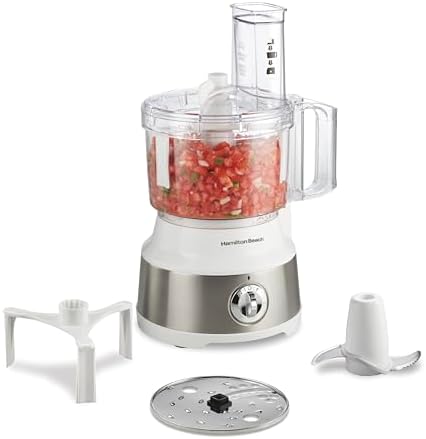
- BUILT-IN BOWL SCRAPER SAVES TIME: Quickly process ingredients without pausing to use a spatula. Simply move the scraper …
- SLICE, SHRED, CHOP, MIX, & PUREE WITH 2 VERSATILE ATTACHMENTS: This veggie slicer and processor includes a stainless ste…
- POWERFUL 450-WATT MOTOR: Make healthy salads, homemade salsa, hearty acai bowls, and more with this food processor and v…
Who it’s for: Occasional cooks and tight budgets.
Key specifications (Hamilton Beach and Tom’s Guide):
- 10-cup bowl
- 450-watt motor, two speeds plus pulse
- S-blade, reversible slice/shred disc, and a built-in bowl scraper
- Dishwasher-safe removable parts
- 1-year limited warranty
Details are on Hamilton Beach’s official product page.
What it does well: Tom’s Guide named it best value. Its testers reported the 450-watt motor chopped an onion in three seconds and grated cheddar in five, among the fastest in its tests. It also handled sticky cookie dough without motor strain.
Important limitations:
- Tom’s Guide measured 93.9 dB, among the loudest it tested.
- The light 6.9-pound frame rocked slightly during dough.
- The scraper stops about an inch from the bottom, and attachments are limited.
- The model is sold under variants (70730, 70730G, 70730C), so check the exact listing.
Best uses: Chopping, shredding, quick salsas, and light dough for small households.
Value considerations: At roughly $50 to $70, it’s an easy entry point. If you cook often, a sturdier machine likely pays off.
How We Chose the Best Food Processors
We started with the question: which models do independent testers consistently rate well, and why? We then cross-checked each against manufacturer specifications.
- Independent testing: We compared America’s Test Kitchen, Tom’s Guide, and Food Network, which ran chopping, slicing, shredding, dough, and puree tests.
- Manufacturer specs: We took bowl size, wattage, included blades, and warranty from the manufacturer or its retailers, and flagged discrepancies.
- Practical factors: We weighed feed tube size, cleanup, storage, noise, and price.
- Honest labels: We only used a category (budget, premium, slicing) where evidence supported it.
Specs differ across sources. One retailer lists the Ninja Professional BN601 at 850W, while an Amazon listing title says “1000 Peak Watts.” Food Network lists 450 watts for the Breville Sous Chef 16, while Breville states 1450. We used manufacturer figures where we could.
What to Look for in a Food Processor
A food processor should take on whole vegetables without much prep, stay put on the counter, and be easy to put together and clean. America’s Test Kitchen’s criteria are a useful checklist.
- Capacity of at least 11 cups for most home cooks, which it found the most versatile.
- A responsive pulse button that stops quickly, so you control texture.
- Low, long blades with small gaps from the bowl, so food doesn’t escape.
- Sharp blades, since dull ones bruise herbs and clump cheese.
- A weighty base that doesn’t walk during dough.
- A feed tube that fits real food without extensive trimming.
- Simple parts, since fewer pieces mean easier cleanup.
Food Processor Capacity: What Size Do You Need?
Short answer: For most households of two to four people, 11 to 14 cups is the sweet spot.
Manufacturer cup numbers describe the bowl’s total volume, not how much you can use. Work from these limits instead.
- Liquids: Fill lines are much lower. America’s Test Kitchen measured liquid maximums of about 3 cups for the Cuisinart Custom 14, 2.25 for the Pro Custom 11, 5 for the Breville Sous Chef 16, and 9 for the KitchenAid 13-cup.
- Dough: Flour capacity is the real limit. America’s Test Kitchen found a 9-cup KitchenAid maxed out at about 3 cups of flour, while the Cuisinart Pro Custom 11 handled 4.
- Chopping: Results are best when the bowl is no more than about half full.
As a rough guide:
- One to two people: 7 to 9 cups, or a mini chopper for small jobs.
- Three to four people: 11 to 13 cups.
- Larger households or heavy batch cooking: 14 to 16 cups.
Very large bowls can be worse for small jobs. Tom’s Guide found food migrated to the edges of the KitchenAid’s big bowl, and the GE 12-cup bowl was too large for hummus.
How Much Motor Power Do You Really Need?
Short answer: Wattage is a clue, not a guarantee.
America’s Test Kitchen’s science editor explained that overheating while kneading points to too little torque, not just low wattage. Tom’s Guide’s results show the same pattern. The 450-watt Hamilton Beach was among its fastest at chopping and grating, while the 720-watt Cuisinart did best at dough.
When comparing motors, look at:
- Blade design and bowl fit: Gaps matter for thorough processing.
- Torque and base weight: Dough tests reveal both.
- Continuous versus peak watts: Peak ratings can overstate real power.
- Real tests: Look for dough, shredding, and puree results.
As a loose reference, Tom’s Guide suggests about 500 watts or more for most full-size machines, and notes weak motors can struggle and risk burning out under heavy loads.
Which Blades and Discs Matter?
America’s Test Kitchen found that three blades handle most tasks: chopping, slicing, and shredding. Extras like mini bowls and dicing kits can help, but they add cost, bulk, and cleaning.
- S-blade: Chops, purees, and mixes.
- Slicing disc: Thin for tomatoes, thick for potatoes.
- Shredding disc: For cheese and vegetables.
- Dough blade: Often unnecessary. America’s Test Kitchen wrote a guide on why you can skip it, and Food Network’s testers say the regular S-blade kneads fine.
- Adjustable slicer: Convenient if you slice often, but not essential.
- Dicing kit: Useful in volume, but overkill for a single onion.
Food Processor vs Blender: What Is the Difference?
A food processor chops, slices, shreds, and mixes thick or dry foods. A blender is built for liquids.
| Task | Food Processor | Blender |
|---|---|---|
| Chopping vegetables | Better | Poor |
| Shredding cheese | Yes | No |
| Dough | Yes | No |
| Hummus, pesto | Strong | Possible |
| Smoothies, soups | Weak | Better |
America’s Test Kitchen prefers a blender or immersion blender for pureeing batches of soup, since they reach a finer, smoother texture. Food Network notes a processor is easier for thick purees because it’s simpler to scrape out.
Full-Size vs Compact Food Processors
Full-size (11+ cups): The best choice for versatility. It handles dough and batch cooking and comes with slicing and shredding discs. It uses more counter and cabinet space.
Compact (5–9 cups): Easier to store and good for small households. The tradeoff is capacity. America’s Test Kitchen found a 9-cup KitchenAid couldn’t handle double-batch dough.
Mini choppers (about 3–5 cups): Fine for herbs, nuts, onions, and quick dips. Tom’s Guide tested a KitchenAid 3.5-cup chopper and found it fast for salsa but weak for smooth purees and unable to slice. Check wattage claims on mini models. Retailer listings for one popular 7-cup KitchenAid disagree on whether it’s 300W or 500W.
Choosing size is like choosing between a 2-slice vs 4-slice toaster. The bigger one costs space, so buy for what you actually cook.
Food Processor Features That Actually Matter
- Pulse control: The most important feature for texture.
- Feed tube size: Reduces prep and waste.
- Easy assembly: A twist-free lid or simple stem saves frustration.
- Weight and stability: Heavier bases stay put during dough.
- Clear fill lines: Prevent leaks with liquids.
- Safety interlocks: Breville’s motor won’t run unless the bowl, lid, and large pusher are positioned.
- Warranty: Longer motor coverage, like the Cuisinart’s 5 years or Breville’s 30, is a useful signal, though not proof of lifespan.
Features You May Not Need to Pay Extra For
- Many speed settings: Two or three are enough.
- LCD timers: Nice, rarely essential.
- Dicing and spiralizing kits: Only if you use them weekly.
- A dedicated dough blade: Often optional.
- Sealed bowls for liquids: America’s Test Kitchen calls them nice but not essential.
How Easy Is It to Clean?
Smooth bowls and fewer pieces win. America’s Test Kitchen preferred simple lids and one-piece blades because nooks trap food.
Many parts are dishwasher-safe, but there are caveats:
- Wash blades by hand to avoid dulling them, per America’s Test Kitchen.
- Bowls and lids can cloud over many dishwasher cycles.
- Check each manual. The Breville Sous Chef 16’s bowl and lid are better hand-washed.
- Dry parts completely, since water can collect in pushers.
How Much Counter Space Does a Food Processor Need?
Full-size units are tall and heavy. Check height first. The KitchenAid 13-cup is about 17.4 inches tall and the Breville Sous Chef 16 stands around 17.5, so neither fits under many upper cabinets. The Cuisinart Custom 14 is about 14.8 inches tall, which is shorter, and Tom’s Guide says the Breville Paradice 9 stores its attachments inside the bowl.
Decide which appliances deserve permanent counter space. Daily-use tools like electric kettles and toasters usually earn it. A food processor often lives in a cabinet. Our guide on how to choose the right air fryer covers similar capacity and counter-space tradeoffs.
How Long Should a Food Processor Last?
There’s no standardized lifespan data. Warranties are the clearest signal:
- Cuisinart Custom 14 and Pro Custom 11: 3-year limited unit warranty plus a 5-year motor warranty.
- Breville Sous Chef 16 and Paradice 9: 2-year limited warranty plus a 30-year motor warranty.
- KitchenAid 13-cup and Hamilton Beach 10-cup: 1-year limited warranty.
Owner reviews on retailer sites often describe decades of use, but those are self-selected anecdotes. Replacement parts are worth checking too. Plastic bowls can crack and blades dull, so choose brands that sell replacements.
How to Get Better Results From a Food Processor
- Pulse, don’t run: It prevents over-chopping.
- Cut evenly: Uniform pieces process evenly.
- Don’t overfill: Stay under the fill line, especially with liquids.
- Use cold butter for pastry, as America’s Test Kitchen recommends.
- Knead with the S-blade: Food Network’s testers say a dough blade isn’t required.
- Scrape between pulses for even purees.
- Slice with firm foods upright in the feed tube.
Common Food Processor Buying Mistakes
- Choosing by wattage alone.
- Buying too large and then avoiding it for small jobs.
- Buying too small and struggling with dough.
- Paying for attachments you won’t use.
- Ignoring height and weight.
- Skipping model-number checks. Variants and renamed versions have different specs.
- Putting sharp blades in the dishwasher.
Who Should Buy a Food Processor?
- People who cook from scratch several times a week.
- Meal preppers who chop and shred in bulk.
- Bakers who make pie crust or pizza dough.
- Anyone who makes hummus, pesto, or slaw regularly.
- Households that would use a box grater or mandoline often.
Who May Not Need One?
- People who mostly cook with prepared ingredients.
- Cooks who only want smoothies, where a blender is the better tool.
- Very small households who chop only a little at a time. A knife or mini chopper may be enough.
- Anyone without storage space for a bulky appliance.
Frequently Asked Questions
What size food processor is best for home cooks?
An 11- to 14-cup model suits most. America’s Test Kitchen found 11 cups or more the most versatile for chopping, slicing, and kneading. Smaller households can go smaller, but dough and batches are limited.
Is a food processor worth it for everyday cooking?
Yes, if you cook from scratch. It saves time on chopping, shredding, and slicing, and handles pie dough and sauces. If you rarely prep ingredients, it may sit unused.
How many cups should a home food processor have?
For two to four people, 11 to 13 cups is a safe range. One to two people can manage with 7 to 9 cups. Larger households or batch cooks may prefer 14 to 16.
What can you make in a food processor?
Salsa, pesto, hummus, nut butters, slaw, breadcrumbs, pie crust, pizza dough, and ground meat for burgers. It also slices and shreds cheese and vegetables.
Can a food processor knead dough?
Yes. America’s Test Kitchen and Tom’s Guide both tested dough. Both Cuisinart models handled a double batch of pizza dough in America’s Test Kitchen’s testing. Lighter, lower-torque machines may rock or stall. A dedicated dough blade isn’t required.
Can a food processor replace a blender?
Not fully. It’s better for thick mixtures and dry chopping, but it can’t make smooth smoothies or fine soups as well. Many cooks own both.
What is the difference between a food processor and a blender?
A food processor uses blades and discs for chopping, slicing, shredding, and mixing. A blender uses a tall jar and fast blades for liquids.
How much wattage should a food processor have?
For full-size models, Tom’s Guide suggests roughly 500 watts or more. Wattage isn’t the whole story, though. Torque, blade design, and bowl fit matter, and the 450-watt Hamilton Beach was among Tom’s Guide’s faster performers.
Are expensive food processors worth it?
Sometimes. Pricier models offer more attachments, longer motor warranties, and better build. But America’s Test Kitchen’s top pick and Best Buy are both moderately priced Cuisinarts. Pay more only if you’ll use the extras.
What food processor is best for meal prep?
A larger-capacity model with a wide feed tube. The Cuisinart Custom 14 and Breville Sous Chef 16 both fit. The Paradice 9’s dicing kit helps if you want uniform cubes.
Are food processor parts dishwasher safe?
Often, but check your manual. America’s Test Kitchen advises hand-washing blades and notes bowls can cloud over time. Top-rack placement is common.
How long does a food processor usually last?
There’s no standard figure. Warranties range from 1 year to 30 years on the motor, and results depend on use and care.
Final Buying Considerations
Start with how you cook. If you want one dependable machine, the Cuisinart Custom 14 is the best-supported choice we found, and the Pro Custom 11 is the value alternative. If you slice constantly, consider the KitchenAid 13-cup, knowing the mixed testing. If storage and dicing matter most, the Paradice 9 is worth a look. The Breville Sous Chef 16 suits cooks who will use its attachments, and the Hamilton Beach is a low-cost way to start.
Before buying, confirm the exact model number, check the current price, and read the warranty. Compare current options and see current availability on Amazon.
Note for you, outside the article: KitchenCraftersHub.com blocked my automated access, so I couldn’t crawl it. I used only internal URLs that you gave me, and I included four. Please confirm they resolve, and add a blender-guide link if you have one, since it would fit the “food processor vs blender” section. I also left AMAZON_AFFILIATE_LINK placeholders because I didn’t verify ASINs. I counted those separately from the five editorial external links.
Claude is AI and can make mistakes. Please double-check cited sources.